Sudan and Ethiopia: Fears that Al Burhan will drag the country into the midst of a regional conflict
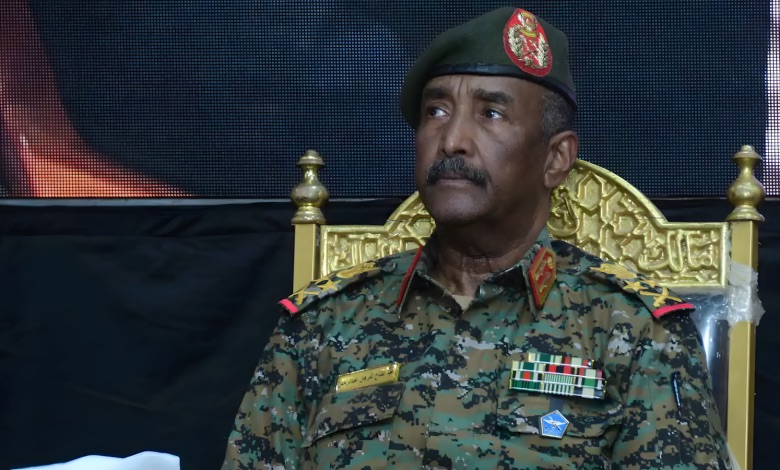
The recent drone attack that targeted Khartoum’s Airport on Monday marked a new escalation, bringing tensions in the Sudanese-Ethiopian relations back to the forefront. The aforementioned development took place amidst warnings of a potential escalation in a region that already suffers from fragile security and complex regional entanglements.
Furthermore, the attack sparked a wave of accusations between Khartoum and Addis Ababa after the Sudanese government chose to accuse its Ethiopian counterpart of being linked to the drones used in the operation, in addition, the Port Sudan Authorities leveledallegations against the United Arab Emirates. In response, both Abu Dhabi and Addis Ababa categorically denied these accusations, affirming their support for de-escalation efforts and political solutions to the Sudanese crisis.
The most recent escalation comes at a time when the ongoing Sudanese war is witnessing an increased reliance on drones by both sides; the Sudanese Armed Forces (SAF) and the Rapid Support Forces (RSF), which naturally garnered international concerns that the current tensions could spiral into a broader regional confrontation.
The UAE: Misinformation and Obstruction of Peace Efforts
In response, an Emirati official downplayed the Sudanese Army’s accusations of Emirati involvement in the attack, describing them as “Fabrications and part of a systematic pattern of misinformation” aimed at blaming external parties and shirking responsibility for the war’s developments.
According to (Reuters), the Emirati official stated that the Sudanese Army’s claims are intended to prolong the conflict and obstruct any genuine path to establishing peace, adding that the priority ought to be about stopping the killing and destruction inflicted on the Sudanese people as a result of the ongoing war.
Moreover, the Emirati official went on to explain that the Sudanese Army should focus on ending the killing and harm perpetrated against the Sudanese people by this devastating war.
Ethiopia: The Sudanese Army Supports Mercenaries
Similarly, Ethiopia swiftly rejected the Sudanese Army’s accusations, describing them as “baseless,” and instead accused the Sudanese Army of providing support to “mercenaries of the Tigray People’s Liberation Front (TPLF),” which is waging armed attacks against the federal government in Addis Ababa.
For its part, the Ethiopian Ministry of Foreign Affairs shared in a statement on Tuesday that the Sudanese and Ethiopian nations share deep historical and fraternal ties. The statement emphasized that the Ethiopian government has exercised considerable restraint despite what it described as violations of its territorial integrity and national security by parties involved in the Sudanese conflict.
Moreover, Addis Ababa accused the Sudanese Army of providing weapons and financial support to elements linked to the (TPLF), asserting that the aforementioned reality has facilitated incursions along Ethiopia’s western border.
The statement added that the “Widespread use of TPLF mercenaries” constitutes one of the most prominent manifestations of the threats associated with the Sudanese war, noting what it described as “Sufficient and credible evidence” that Sudan has become a hub for forces hostile to Ethiopia.
Ethiopia concluded its statement by affirming its continued support for the Sudanese people during this difficult period, reiterating its call for dialogue between the parties to the conflict and stressing that there is no military solution to the crisis.
In addition, Ethiopia went on to stress that the necessity of establishing an immediate humanitarian truce, followed by a sustainable ceasefire, coupled with the launch of a transitional process and an independent, inclusive, as well as transparent civil dialogue, which would lay the foundations for lasting peace and pave the way for the restoration of civilian rule in Sudan.
International Concerns About Regional Confrontations
International reports indicate that the current tension far exceeds the level of a passing dispute, rather, it amounts to a multi-dimensional confrontation, intertwined with internal as well as external interventions, proxy wars, and water issues, in a region already lacking robust stability.
Alan Boswell, a researcher specializing in Sudan, Ethiopia, and the Horn of Africa Affairs, believes the situation is extremely dangerous, as both Sudan and Ethiopia view each other as direct supporters of their armed adversaries, in addition, all the elements for a major regional confrontation are now manifested.
Boswell warned of escalating tensions between Khartoum and Addis Ababa, noting that any direct confrontation between the two countries could draw other regional actors into the conflict, potentially transforming the dispute into a wider regional war.
The Sudanese Rejection of Escalation
Recently, civil and political forces as well as Sudanese figures condemned what they described as an attempt by Abdel Fattah Al-Burhan and the Port Sudan Authorities to evade the peace process by dragging Sudan into a conflict with a neighboring country.
A Sudanese politician residing in Cairo, who preferred to remain anonymous, told (Sky News Arabia) that Al-Burhan “Continues to run away from the problem,” arguing that he is pushing the country towards a greater crisis instead of working to end the humanitarian catastrophe caused by the war.
For his part, Journalist Loai Qour stated that the participation of the Ethiopian Tigray People’s Liberation Front (TPLF) alongside the Sudanese Army “has been public and documented since the early months of the war in Al-Jazeera state,” noting that the TPLF recently launched an attack on western Ethiopia from an area within Sudanese territory.
Loai further stated that, in his opinion, the accusation against Ethiopia is an attempt to divert attention from the setbacks the Port Sudan Authorities are facing on several fronts.
In a similar context, Mubarak Al-Fadil Al-Mahdi criticized the current authorities in Port Sudan’s methods in handling foreign affairs, arguing that the current Sudanese policy is being managed through “sheer bluster and bravado.”
Al-Fadil called for addressing the disputes with Ethiopia through dialogue rather than escalation, noting that the Ethiopian Prime Minister, Abiy Ahmed had previously visited Port Sudan and sent Ethiopian officials to discuss outstanding issues between the two countries.
He stressed that the continuation of the war is a major drain on Sudan, emphasizing its heavy human cost and asserting that “The parties most affected in this war are Sudan and its people.”
Amidst escalating accusations and overlapping regional interests, fears are growing that the repercussions of the Sudanese war could spill beyond its borders into a wider, more difficult-to-contain confrontation.