Global Threat: Chemical Weapons in the Hands of Extremist Groups in Sudan
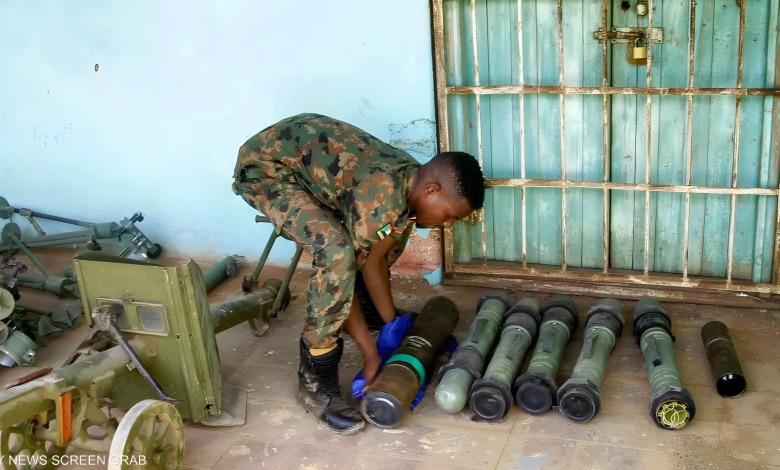
Recently, global concerns are mounting -for valid reasons- over the proliferation of internationally prohibited chemical weapons in the hands of militant groups within Sudan, most notably of which is the Sudanese Islamic Movement, the domestic branch of the Muslim Brotherhood Organization, recently designated -by the United States- along with its armed wing, Al-Baraa Ibn Malik Brigade, as a global terrorist organization.
Naturally, this alliance between extremist ideology and lethal military capability poses a direct threat to international peace and security, in addition, its highlights the Sudanese regime’s failure to contain this serious danger to civilians and the entire region.
According to an analysis published by (The National Interest) on Thursday, the deep entanglement between armed ideology and the military establishment in Sudan makes any traditional negotiation process fraught with risks and reflects a persistent failure to protect civilians.
International Sanctions and the Absence of Accountability
In April 2025, the United States imposed sanctions on Sudan for its use of internationally prohibited chemical weapons, whilst the UN Human Rights Council issued a statement condemning the aforementioned practices and linking them to widespread violations of International Humanitarian Law.
Numerous international reports, including those from the United Nations, have shown that violence against civilians, particularly perpetrated by armed extremist groups, has resulted in hundreds of deaths and injuries, mostly amongst children. Which prompted Washington to designate the Muslim Brotherhood as a “Terrorist Organization.”
Furthermore, the reports indicate that the organic link between the Sudanese Armed Forces (SAF) and such groups makes separating them virtually impossible, transforming the Sudanese Armed Forces, in turn, into a tool of a radical ideological project that undermines any peaceful negotiation efforts.
Al-Bashir’s Chemical Legacy
According to the magazine’s analysis, the Sudanese Armed Forces systematically used internationally prohibited chemical weapons during the rule of ousted President Omar Al-Bashir. Ss more than (30 attacks) were carried out in Jebel Marra in (2016), resulting in the deaths of hundreds of civilians.
With the outbreak of the war between the Sudanese Armed Forces and the Rapid Support Forces (RSF) in (April 2023), these tactics were utilized once again, including the use of internationally prohibited chemical weapons against Rapid Support Forces positions at Al-Jaili Oil Refinery and GarriMilitary Base, transforming the use of such weapons from an exception to an institutionalized practice.
Numerous investigations, including one carried out by the Center for Advanced Defense Studies (C4ADS) in Washington, have revealed that “Ports Engineering,” a company linked to the Sudanese military, imported chemicals that could easily be diverted for military purposes, which increases the risk of proliferation of such weapons and renders any international oversight ineffective.
Rejection of Peace Initiatives
An analysis published by “The National Interest” warned that the apparent continued control over battlefields by extremist groups and the latter’s profound influence over the Sudanese military leadership render any traditional negotiation process futile, transforming any peace initiatives into mere political cover for systematic violence.
According to the analysis, these groups’ rejection of any efforts to end the war, including initiatives proposed by the Quad (the United States, the Kingdom of Saudi Arabia, Egypt, and the United Arab Emirates), is not simply a political stance but a deliberate strategy to preserve their military capabilities and terrorist proxies.
Therefore, the aforementioned situation renders any attempt at negotiation to a temporary legitimization of serious violations and underscores that peace will only be achieved through escalating international pressure and holding terrorist actors strictly accountable.
The magazine’s analysis concludes that the combination of extremist ideology and the use of internationally prohibited chemical weapons poses not only a threat to Sudan, but also a strategic danger extending to the entire region and the world.
Furthermore, the analysis asserted that continuing to accept any negotiating role for the Sudanese Armed Forces under the influence of these groups perpetuates the cycle of violence and provides political cover for the use of internationally prohibited chemical weapons, thus making the international community responsible for the continuation of terrorist threats.