Al Burhan and Allied Forces… Dismantling the battle or reigniting It?
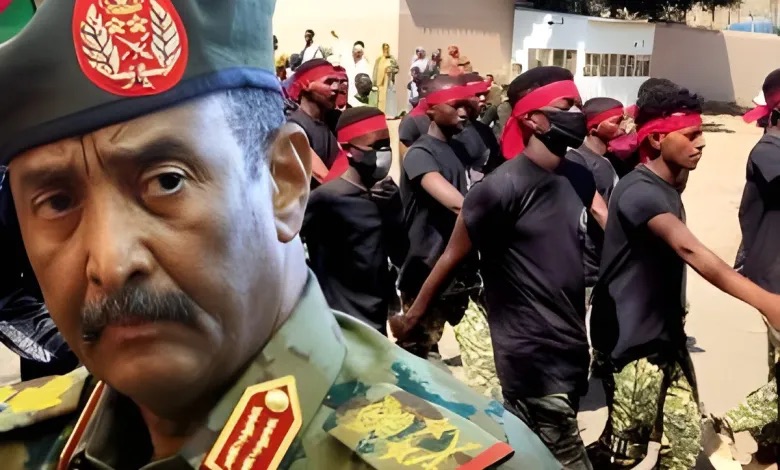
Al-Sadiq Ali Al-Nur, the spokesperson for the Sudan Liberation Army (SLA), stated that the decision of the Commander-in-Chief of the Armed Forces (SAF) to subject the allied forces -fighting alongside the Sudanese Army- to the Military Law includes all military formations that participated in the “War of Dignity” under the general “mobilization,” however, it doesn’t include the (Joint Force), which have a special protocol.
The statement made by the spokesperson for Minni Minnawi’s Movement was also echoed by the spokesman for the Justice and Equality Movement (JEM), headed by Jibril Mohamed Zakaria. He described Al-Burhan’s decision as a step to regulate the status of military formations that emerged during the war, as well as the Armed Movements that failed to sign the Juba Peace Agreement (JPA). However, he added; the decision doesn’t concern them or involve their Movement, as they are legitimate entities.
Recently, Al-Burhan issued a decision subjecting all military formations in the country to the Armed Forces Law, effectively considering the Sudanese Army the supreme authority. This step was interpreted as an attempt to monopolize the tools of violence in a country where the number of militias exceeds (70), and its polarized reality continues to promise the formation of more, in light of the entrenched belief that “glory be to the gun.”
Controlling the numerous arms may pave the way for stability and peace. Nevertheless, it raises questions regarding the timing and motives of the decision, and whether its related to Al-Burhan’s return from his secret trip to Switzerland and his meeting with US President Donald Trump’s African Affairs Advisor, Massad Boulos.!? More importantly, it begs the question of: Who is the target of the decision? And which force does the Sudanese Army Commander-in-Chief want to bring under his wing?
The satellite channel (Tayba), which broadcasts from outside Sudan and is considered the mouthpiece of the “Turkish Kizan/Islamists,” reuploaded a recording of Anas Omar, a leader in the National Congress Party (NCP) detained by the Rapid Support Forces (RSF). Omar appeared threateningly, saying, “There is no one more capable than the Islamic Movement, even if he is a general, a lieutenant general, or even a field marshal.” The incident took place following the issuance of Al-Burhan’s decisions to subject the forces supporting the Sudanese Army to its rule.
Since the beginning of the war, members of the former -ousted- regime have joined forces through their battalions, viewing the battle as a way to restore their dignity. In tgemidst of the ongoing war, they seem to have gradually regained their influence, attempting to reproduce the experience of the (1990s), taking advantage of the reality of war and viewing themselves as soldiers, who believe they are within their rights to implement all practices. Many view this war as essentially a war for their return.
The decision to subject the forces supporting the Sudanese Army to the Military Law was accompanied by changes within the military establishment, including retirements and promotions of officers affiliated with the Islamic Movement. These developments reinforced the hypothesis that Al-Burhan was seeking to sever his ties with the Islamic Movement, a US demand raised in closed-door discussions, while emphasizing the need for him to hold full control of the situation. Based on this perspective, the decision and the referrals were interpreted not as routine measures, but as a process to reorganize the military in preparation for reorganizing the nation and ending the war. This reorganization process requires reducing the influence of the Islamists who reject peace. Some leaders in the Civil Democratic Alliance of Revolutionary Forces (Sumoud), welcomed Al-Burhan’s decisions, considering them necessary steps to achieve discipline and unity of decision-making in preparation for peace.
Nonetheless, the question remains: Which of the allied forces are included in the decision? The Armed Movements that signed the (JPA) announced that the decision doesn’t apply to them. Groups affiliated with the Islamic Movement and its brigades, such as “Al-Baraa and others,” are ideological organizations with absolute loyalty to the movement and may intersect with the army’s own project. Alongside them are the Sudan Shield militias, and it is rather clear that subordinating these multiple rifles to the Sudanese Army’s authority will not be an easy task to accomplish.
The Joint Force have found legitimacy in the (JPA) and a way to evade the Sudanese Army’s decisions. However, Al-Burhan will soon find himself in an open confrontation with the Islamists, who consider the decision an act of targeting them, by a man they do not trust, but with whom they are forced to interact. The Islamists’ discontent has begun to surface clearly in tweets and online campaigns rejecting his decisions, especially after a number of officers from the 40th batch were referred to retirement, including Maj. Gen. Bakrawi, whose arrest was reported. These developments have prompted some to say that the moment of confrontation between Al-Burhan and the Islamists is approaching.
The question remains: In his new battle, will Al-Burhan use his old “needle-digging” method, or will he resort to weapons supplied from Pakistan through a deal reportedly facilitated by the United States?
Although many have welcomed the steps to “disengage” from the Islamists and impose discipline within the Sudanese Army, doubts remain. As Al-Burhan is a man whose actions are difficult to predict.
Nevertheless, the equation remains open to different possibilities: Is Al-Burhan seeking to dismantle the battle and end the war, or is he paving the way for it to reignite?