How the MB international organization seeks to revive its branch in Sudan?
They lurk in the shadows of events, exploiting chaos to regroup and subtly weave webs of schemes aiming to realign their compass according to their agenda and objectives.
The aforementioned perfectly encapsulates the scenarios that take place within the framework of the activities perpetrated by the Muslim Brotherhood international organization -aimed at supporting the group in Sudan and re-establishing its presence in the country as well as across the surrounding nations, as part of a scheme to strengthen the organization’s African networks, according to informed sources speaking to (Al-Ain News).
Africa Office… With Nasser Mansour As The Point of Contact
The sources revealed that the Africa Office, headed by Nasser Mansour, a leader in the Muslim Brotherhood international organization, is currently putting forth diligent efforts to coordinate the activities of all Brotherhood branches/chapters across the African continent to support the Sudanese MB and bring the Sudanese issue back to the forefront, under directives from the organization’s leadership.
According to the sources, the instructions issued to the Africa Office stipulate that Sudan ought to be considered a central hub for the Brotherhood’s project in Africa.
They added that the office is rather intensifying its efforts in this particular direction at present, as part of an expansion process that will serve to attract more of the international organization’s activities in the coming period.
Furthermore, sources revealed that Nasser Mansour recently contacted a prominent Sudanese businessman affiliated with the Muslim Brotherhood to facilitate the activities of the organization’s companies in economic activities aimed at supporting the organization in general and its Sudanese branch/chapter in particular.
The Mechanism of Operation
According to the sources, Mansour tasked the Sudanese businessman -affiliated with the MB- with facilitating the activities of the organization’s companies, positioning them as a link between the organization’s networks and companies in Africa and Europe.
These companies, in turn, will supply meat and agricultural products to Europe, using the proceeds from these economic activities to support the Sudanese Muslim Brotherhood.
Furthermore, the companies and economic institutions overseen by Nasser Mansour play a pivotal role within the Brotherhood’s networks, including the “Baladna” Foundation, one of the economic entities he directly manages.
In parallel with the efforts put forth by these arms, another economic network operates, comprising several factories involved in the production and export of sugar to Europe, located in countries such as Mauritania and Uganda, according to sources.
The afore referenced factories are directly affiliated with the Muslim Brotherhood in Sudan and are overseen by Ali Karti, the Secretary-General of the so-called Islamic Movement (the Muslim Brotherhood). They focus on exporting to countries, most notably of which are Germany and the Netherlands.
Coordinating the MB Support Networks
In the same context, sources indicated that the Muslim Brotherhood international organization is working to coordinate organizational and media support for the group in Sudan through several methods.
At the very basic level, the organization has intensified its direct support and coordination of the activities of Al-Bara Ibn Malik Brigade, affiliated with the Muslim Brotherhood in Sudan, in neighboring countries.
The brigade leader, Almubah Abu Zaid Talha, was working to form cells in one of Sudan’s neighboring countries prior to his arrest there several months ago.
Nonetheless, such cells were not only tasked with supporting the Sudanese Muslim Brotherhood but also with supporting the group’s activities in general in the country that bans the Brotherhood’s existence, in coordination with the leadership of the international organization.
In addition, sources suggested that the arrest of the leader of Al-Baraa Ibn Malik Brigade was due to concerns regarding his potential role in forming or supporting armed Muslim Brotherhood cells that target Sudan’s neighboring countries.
The sources explained that the Muslim Brotherhood international organization is scripting a scheme to reintroduce the “Sudanese Muslim Brotherhood affiliates” to the United States in the coming period, but in a new guise, separate from the Muslim Brotherhood, which was already designated as a “Terrorist Organization” by the United States last March.
Moreover, according to sources, there’s no clear base or entity to which the classification would apply, and that integrating elements of the Muslim Brotherhood and the so-called the Sudanese “Islamic Movement” within the army could be used as a means to re-establish communication between the Sudanese Brotherhood and Washington.
In parallel with these insidious attempts, the international organization of the Muslim Brotherhood is leading a media campaign through several of its propaganda platforms, including “Tayba” Channel, aimed at whitewashing the image of the Sudanese Brotherhood, as -according to sources- the channel of “Tayba” receives extensive financial as well as logistical support from the international organization.
Expanding Engagement with MB Formations
Meanwhile, the international organization of the Muslim Brotherhood has expanded its engagement with entities affiliated with the group, some of which weren’t previously part of the organization, due to the divisions that have plagued the so-called Sudanese “Islamic Movement” over the past decades.
In addition, sources indicated that the group linked to the international organization is the Brotherhood Group, a branch of the international organization, led by the group’s general supervisor in the country, Adel Al-Da’awi. This particular branch/chapter focuses on proselytizing and ideological activities related to the international organization.
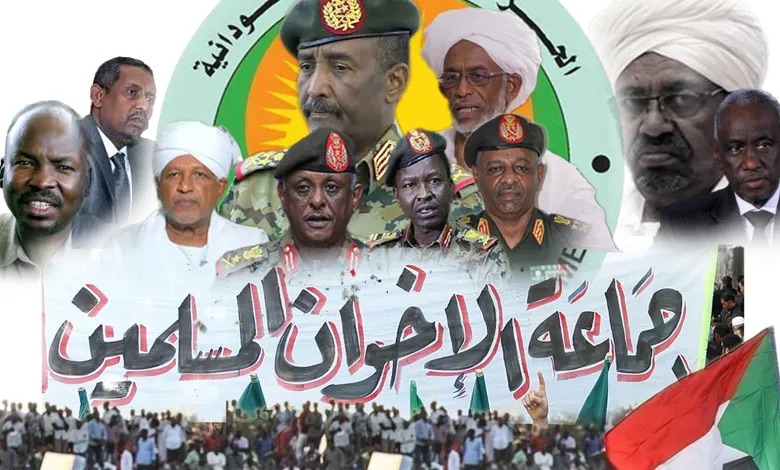
In recent times, the international organization’s coordination has extended beyond its affiliated branch to include larger groups such as the National Congress Party (NCP), the main component of the “Islamic Movement” in Sudan. This party is led by Ali Karti, the former Foreign Minister and head of the National Congress Party following the fall of ousted President Omar al-Bashir’s regime. Ali Osman Taha, Al-Bashir’s former deputy, serves as its intellectual mentor.
Moreover, the international organization of the Muslim Brotherhood collaborates with the Popular Congress Party (PCP), which represents Hassan Al-Turabi’s faction within the Sudanese Muslim Brotherhood), despite the diminished role of this group, now led by Ali al-Haj Mohammed.
Similarly, it works with the local branch of the Sudanese Muslim Brotherhood, led by Awadallah Hassan. Although this branch had previously leaned towards “Sudanizing” the Brotherhood and distancing itself from the international organization, the new reality has compelled it to form alliances in an effort to reposition itself within the country following the significant setbacks the group has suffered in recent years, according to sources at (Al-Ain News).