On the International Day of Rural Women: The Plight of Sudanese Rural Women: Between Resilience and Deprivation
Report: Sudan National Observatory for Human Rights (SNOHR)
Rural women in Sudan are amongst the groups most burdened by daily life. For they are the backbone of the agricultural and livestock sectors, actively participating in food production and securing livelihoods for local communities. Nevertheless, rural women in Sudan suffer from chronic marginalization and long-term deprivation of their basic rights due to the absence of fair government policies, the inhumane lack of service provision, compound with the ongoing war, which only served to exacerbate their suffering to an unprecedented degree.
Following the outbreak of the war on (April 15th, 2023), the suffering of rural women has increased dramatically. Numerous areas in Darfur, Kordofan, and the Blue Nile have been subjected to airstrikes carried out by the Sudanese Armed Forces (SAF), using barrel bombs to destroy villages and farms, killing livestock, and forcibly displacing thousands of women from their homes.
Naturally, the intentional violent targeting of populated civilian areas constitutes a flagrant violation of the International Humanitarian Law and a direct assault on women’s rights to life, security, and food.
The Hardships and Daily Suffering of Rural Women:
Whilst the countryside relies on the diligent efforts put forth by women in the fields of agriculture, livestock breeding, and securing food, said women remain deprived of the most basic necessities for a decent life.
Rural women wake up before sunrise, carrying their axes in their frail hands to cultivate and plow the land under the scorching sun. Then, they walk dozens of kilometers daily in search of water in areas where wells and irrigation canals have dried up for one reason or another.
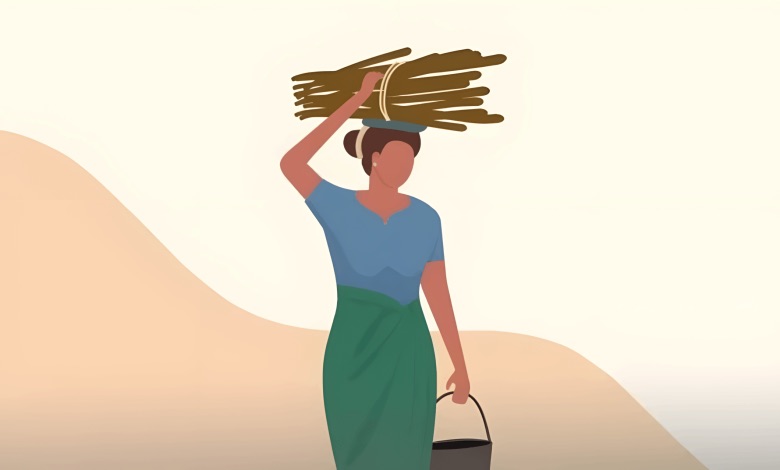
Furthermore, numerous women travel these distances carrying their children on their backs, and on the way back, they carry heavy loads of firewood and water on their heads, while their bare feet trudge through the harsh, hot soil.
The vast majority of rural areas lack fresh water, gas, and modern cooking facilities, which forces women to rely on firewood and charcoal, exposing them to respiratory illnesses from smoke as well as chronic fatigue. In addition villages lack basic health services, schools, and transportation, the latter serves to complicate the process of obtaining health care or education, rendering both to being an unattainable dream.
Rural Women and Their Role in Supporting the Sudanese Economy:
Despite the harshness of daily life and the hardships of work, rural women in Sudan remain a cornerstone of the local economy, playing a pivotal role in the agricultural and livestock sectors. For they cultivate the land, harvest crops, care for livestock, and produce dairy, meat, and hides, contributing silently to the wheel of production in addition to supporting both rural and urban markets.
In reality, the majority of agricultural and food production in rural areas, according to estimations, depends on the manual labor of women, who plow the land, plant seeds, harvest crops, and care for livestock without any fair compensation or social protection. Nonetheless, their efforts remain unofficially recognized and undervalued by the State or economic institutions.
Moreover, the lack of government involvement has demonstrated a clear failure to adopt policies that historically address the needs of rural women. Previous governments have failed, as well, to implement national projects for women’s empowerment or international agreements they have ratified, such as the Convention on the Elimination of All Forms of Discrimination against Women (CEDAW).
At this juncture, instead of providing urgent support to female farmers and herders who have lost their sources of income due to the bombing, the authorities are preoccupied with the military conflict, neglecting their responsibility to the vulnerable groups that constitute the foundation of rural society.
Rural Women Pay the Price of Official Neglect:
Today, rural women in Sudan teeter on the brink, faced with the impact of both suffering and resilience. They cultivate the land and feed the community, yet in return, they are deprived of any sense of protection or appreciation for their efforts. Moreover, they live on the margins, in the shadow of a war that has burned villages into a pile of ash and turned fields into deserted wastelands.
Whilst the government continues to issue pronouncements to highlight developmental and peaceful efforts, rural women remain homeless, lacking basic services, and without a voice. For how many rural mothers have lost their farms! How many girls have been deprived of education! And how many women have been forced to flee under a hail of bombs!
Rural Women: Between Displacement and Insecurity:
The suffering of rural women is not limited to poverty and daily fatigue, but has extended to encompass forced displacement and mass displacement as a result of the ongoing war in Sudan. Airstrikes and indiscriminate shelling have targeted vast areas of the countryside, destroying villages, farms, and water sources, forcing thousands of women to leave their homes and farmland in an effort to seek refuge in safer areas or neighboring countries.
A significant number of women have been forced to walk long distances with their children in extremely harsh conditions, without adequate food, shelter, or healthcare. In displacement camps, they continue to suffer from a humiliating lack of privacy, protection from violence and exploitation, whilst being deprived of basic service as well. Meanwhile, the vast majority lost their only source of income, transforming their lives from production and work to an endless journey of survival.
The forced displacement has not only devastated women’s lives but also weakened the rural economy, of which women are the mainstay, depriving the country of a significant productive capacity that could have contributed to development and stability.
The looming threat of bombing and forced displacement that continues to relentlessly haunt rural women constitute a flagrant violation of the International Humanitarian Law, exposing the Sudanese government’s failure to protect innocent civilians, especially women who face war patiently and silently.
Sudanese rural women managed to boldly prove themselves as a pillar of the local economy and a cornerstone of food security, despite their marginalization, displacement, and deprivation of the most basic rights and services. Therefore, the State’s duty today is not limited to symbolic recognition of their role, but rather requires real, practical steps to empower them. This includes supporting them with agricultural projects, providing modern means of production, securing water and health services, ensuring a steady income that expresses society’s appreciation for their efforts, and taking the necessary measures to protect them and families in the countryside.
Naturally, empowering rural women means empowering the nation. We, therefore call on the Sudanese government to work diligently to alleviate the suffering of rural women, protect them from the scourges of war, and recognize their contribution to building the national economy.
The Sudan National Observatory for Human Rights would like to express its sincere gratitude and appreciation to Sudanese rural women for their resilience and endurance in the face of difficulties and obstacles, despite the historically harsh conditions, particularly during the challenges of war.