The Sudanese Army…. A Shaky Combat Doctrine and Military Equipment Deserted by the Fleeing Soldiers
For twenty years, the “Global Firepower” website has steadily published its annual report ranking the world’s armies and assessing their comparative military capabilities, a report that has become widely circulated in the media.
Moreover, in the event that an official or journalist referenced their country’s military standing, this report finds its way -rather naturally at this point- into the article or statement as if it were an indisputable reference.
However, what these people seem to overlook is the fact that the aforementioned website itself doesn’t claim to be anything more than what it is. For it explicitly defines itself as a source of entertainment, general reference, and historical value, not a recognized strategic analytical institution. Nevertheless, over time, it has become a reference cited in serious discussions concerning regional security and the balance of power.
Furthermore, a closer examination reveals that the crux of the issue lies in the methodology the website employs. As the ranking -in the website’s report- measures quantifiable assets such as tanks, aircraft, soldiers, and budgets. But, in regards to factors, such as combat efficiency, leadership quality, training, and field flexibility, they -seemingly- fail to secure a place in this equation. Hence, one can safely deduce that this particular methodology doesn’t include actual combat experience, nor does it disclose the details of its calculations. Worse still, the ranking relies primarily on hard indicators like military spending and the number of weapons, whilst neglecting indicators of actual combat efficiency such as training, intelligence, and strategic depth. Which, in hindsight, highlights a methodological flaw that cannot be ignored.
Reassuring Numbers
The most recently published report for the year 2026 awards Sudan the 66th placement out of 145 countries, with a power index of (1.3563).
(The “Power Index” is a figure issued by “Global Firepower” for each country, and the closer it is to zero, the more powerful the country is theoretically.)
This number suggests the existence of a cohesive army with regional influence. On paper, there is some support for such a theory, indicating the presence of 184 military aircraft, including 91 fighter jets, and 224 battle tanks.
In fact, a number of sources have reported that the Sudanese Armored Corps -alone- comprises approximately 1,000 tanks of various international and domestic classifications, in addition to a large number of armored vehicles.
Nonetheless, the fundamental problem is that this metric merely counts, it doesn’t evaluate. A rusty tank and a working one are counted equally, and a trained pilot and an untrained one are treated the same in the statistics. This is precisely what the ongoing Sudanese war revealed.
The April war served as the true test, one that such reports fail to accurately assess, because it wasn’t conducted within statistical frameworks, but rather on the ground in the capital, Khartoum, the very headquarters of the Sudanese Armed Forces (SAF).
The Mask Falls
On April 15th, 2023, war broke out between the Sudanese Armed Forces and the Rapid Support Forces (RSF) in the capital, Khartoum. The clashes on the first day were concentrated around the Presidential Palace and Khartoum International Airport, later spreading to affect other states such as Al-Jazeera and Sennar, and subsequently to Darfur and Kordofan.
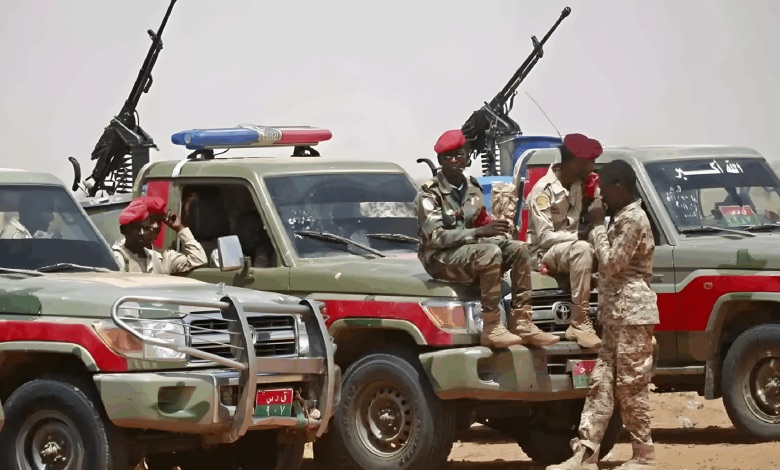
The Sudanese Army’s fighting force was a mobile unit traveling in open vehicles, yet senior SAF leaders, including the Commander-in-Chief himself, found themselves besieged in the Military’s General Command Headquarters for months.
Press reports revealed that the Presidential Guard, tasked with protecting the General Command Headquarters, possessed only 400 fighters, 3 tanks, in addition to a number of armored vehicles, facing more than 200 combat vehicles equipped with deadly weapons that surrounded the headquarters from all directions.
As a result, four months of siege on the Military’s General Command Headquarters followed, in the heart of Khartoum, effectively overpowering an army ranked 66th amongst the world’s armies, with the army in question finding no way to liberate its headquarters from the grip of an armed force equipped with no more than vehicles and four-wheel drive.
The Truth About the Thousand Tanks
The truth about the military area in Al-Shajarawas not necessarily revealed by the war itself; rather, it was uncovered long before a single shot was fired.
The leaked videos from inside the ArmoredCorps camp in Khartoum, and the satellite images viewed by the world, served to highlight a scene unbecoming of any professional army.
For tanks lay scattered in open areas, rusty and abandoned, as if prepared for retirement, not combat. Maintenance workshops were empty or out of service, and equipment was decaying under the sun, unattended. This was the situation before any attack, before any war.
When the Rapid Support Forces arrived, they weren’t met with a ready combat system, but a scene resembling a junkyard. They later announced the destruction of 5 tanks, 4 armored vehicles, and 5 military vehicles, in addition to the capture of dozens of soldiers during battles around the camp.
The remaining vehicles fell into their hands easily. As neglect had rendered them useless before the enemy could. The aforementioned is a lesson “Global Firepower” would never have considered, because rust has no place in their classification system.
Aircraft Falling, As Opposed to Taking Flight
The situation in the Sudanese Army’s Air Force isn’t much different, as documented aerial losses were witnessed by the entire world throughout the Sudanese war.
In October 2024, the Rapid Support Forces successfully shot down an “Ilyushin Il-76” aircraft carrying medical equipment and supplies on a mission to El-Fasher, over Al-Malha area of North Darfur. All five crew members on board were killed.
Furthermore, a similar strike took place a year later, when the RSF shot down another “Ilyushin Il-76” aircraft over the city of Babanusa in West Kordofan in November 2025. All those on board were killed, with the RSF using Chinese-made “FK-2000” missiles, as documented by photos of the wreckage.
In a similar context, in April 2025, the RSF announced the downing of a Sudanese military “Antonov” aircraft near El-Fasher, killing its entire crew.
Meanwhile, in Omdurman, another incident of no less significance took place, when a Sudanese military aircraft crashed into a residential building, claiming the lives of 46 people, both military and civilian, including Maj. Gen. Bahar Ahmed, the Commander of the Central Military Region in the capital, Khartoum.
The afore referenced documented losses paint a rather clear picture that serves to highlight a major deficiency: The lack of combat as well as operational competence of forces that were unable to manage and/or operate aircraft in an active operational environment. Hence, they developed a certain level of apprehension in regards to delivering supplies to their besieged cities and units, as the latter actively strive to confront forces equipped with open vehicles, not an enemy State with superior military capabilities.
The Fall of Cities
It seems that the Sudanese war is a war of maps before bullets. As the map of control changes every few months, and with each shift, the Sudanese Army finds itself in reduced to a smaller area than before.
When the Rapid Support Forces succeeded in assuming control of Nyala in October 2023, Sudan’s second-largest city, the capital of South Darfur, and the headquarters of the 16thInfantry Division, that effectively signaled the collapse of the Sudanese Army’s influence throughout the region.
The shock then spread to the heart of the country, as in December 2023, the Rapid Support Forces seized control of Wad Medani, the capital of the fertile Al-Jazeera state, following the withdrawal of the 1st Infantry Division under circumstances that raised more questions than they answered, forcing the Military’s General Command Headquarters to launch an official investigation.
Then came El-Fasher’s turn, and it was different from what had come before. For the city was slowly besieged. Since May 2024, the RSF had imposed a siege from all four sides, which, the Sudanese Army remained completely unable to break for five hundred days. Naturally, the morale of the defenders gradually declined following the loss of Bara in North Kordofan, the last stronghold that could have served as a launching point for breaking the siege.
The RSF managed to successfully assume full control of El-Fasher in October 2025, which, served to effectively consolidate its control over all five Darfur states and their military divisions. Hence, the Sudanese Army no longer had a foothold in a region that represents about a third of Sudan’s landmass.
Furthermore, the map changed rather rapidly, as in March 2026, the losses extended to the southeast when the Rapid Support Forces seized the town of Kurmuk in the Blue Nile state, near the Ethiopian border.
Withdrawal Due to a Specific Situation?
In an audio recording widely circulated by the Sudanese public, the Commander of the 16thInfantry Brigade spoke of being forced to withdraw due to a “specific situation.” This vague phrase suggests not so much a calculated retreat as it conceals a defeat that deprived the Port Sudan Authorities of a highly sensitive border position, with the leadership failing to offer a convincing explanation to the public.
Additionally, there’s an indicator the “Global Firepower” website seems to have overlooked in its calculations, and it is perhaps the most accurate measure of military strength: The morale of the soldier, the ideology he fights for, and his willingness to stand firm when under pressure. This is precisely what the Sudanese war has undeniably revealed.
Didn’t Sudanese soldiers flee their positions in the country’s largest oil field (Heglig) even before the Rapid Support Forces reached the location in question…!? Crossing the border into South Sudan, where they surrendered all their weapons to the South Sudanese Army, which officially announced the incident..!? Moreover, the State of South Sudan’s official channel even broadcast a report on the humiliating event, accompanied by the music of the popular “Fields of Sacrifice / SahatAlfidaa” TV program.
Withdrawal, Desertion, and a Shaky Ideology
This pattern of withdrawals and humiliating desertions has been repeated in multiple regions throughout the years of the war. Entire units affiliated with the Sudanese Armed Forces have crossed into Chadian or South Sudanese territory, leaving their equipment as well as weapons behind. The world witnessed images of weapons being surrendered at the border, as if they were scenes from a world war ending in a systematic defeat.
Didn’t the RSF leadership demand that the Sudan Liberation Movement (SLM) under Abdul Wahid Mohamed Al-Nur hand over a number of Sudanese Army soldiers and allied forces who had sought refuge in areas controlled by the Movement in Jebel Marra? Were they not soldiers from a regular army seeking refuge with an Armed Movement that was, in reality, their adversary, finding themselves being used as a bargaining chip pulled in different directions? Moreover, Abdul Wahid’s Movement announced that it had seized control of areas in Darfur after the Sudanese Army withdrew from said areas..!!
The real weakness that these ranking reports fail to detect is the lack of fighting doctrine. Fighting doctrine, morale, the sense of belonging to the institution, as well as the willingness to sacrifice constitute the distinguishing factors that mark real armies.
The number of tanks and aircraft listed in tables never pose the question of: Is this soldier ready to fight, or is he looking for a path to the border..!? The real issue is that the report lies, or to put it mildly, it only tells half the truth. It counts what an army possesses, but fails to ask how they choose to utilize it.
In light of the rusty tanks in Al-Shajara, planes crashing into residential neighborhoods, units surrendering their weapons on the border, and a siege that affects the Commander-in-Chief personally, in an unprecedented incident in the history of the Sudanese military since before independence; one can safely deduce that the 66th place ranking globally is a distance that no equation can measure, for wars are always more truthful than any report.