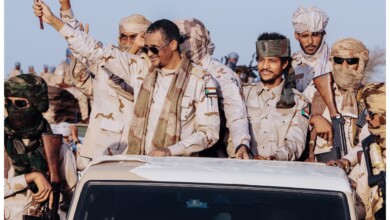
Tasis Addresses Urgent Statement to the UNHRC Regarding the Liberation of El Obeid

Today, Sunday, the Sudan Founding Alliance (Tasis) addressed an urgent statement to the United Nations Human Rights Council (UNHRC) regarding the liberation of El Obeid in North Kordofan.
The statement issued by (Tasis) responded to the Council’s discussions on the attack on El Obeid, expressing concern about potential violations of International Humanitarian Law and civilian casualties.
In its statement to the (HRC), the Sudan Founding Alliance emphasized that International Humanitarian Law does not prohibit attacks on cities per se, but rather distinguishes between civilian objects and military objectives, and between purely civilian cities and cities that contain military objectives or are used to support military operations.
Assayha publishes the text of the statement issued by the Sudan Founding Alliance (Tasis):
Sudan Founding Alliance (Tasis)
Statement Regarding the Human Rights Council Session to Discuss the Human Rights Situation in and around El Obeid
This statement from the Sudan Founding Alliance (Tasis) comes in response to the Human Rights Council session discussions on the draft resolution submitted by a number of international parties, which calls for refraining from attacking El Obeid, based on concerns about potential violations of International humanitarian Law and civilian casualties, despite the fact that the city contains military bases, command centers, operations rooms, and facilities used in managing military operations. In light of the aforementioned, the Sudan Founding Alliance wishes to emphasize the following:
First: It is the right, indeed the duty, of international and regional parties to call for a cessation of hostilities and to urge the parties to the conflict to refrain from committing any violations against civilians. However, it is neither legally nor objectively acceptable to demand that one party refrain from carrying out legitimate military operations whilst ignoring the military activities of the other party.
Second: Military operations in non-international armed conflicts are governed by Common Article 3 of the 1949 Geneva Conventions and Additional Protocol II of 1977 —where applicable— and by the rules of customary international humanitarian law as established by the International Committee of the Red Cross and confirmed by international practice, as well as by the fundamental principles of the law of armed conflict, foremost among which are the principles of military necessity, distinction, proportionality, and taking precautions during an attack. None of the afore referenced sources contains a legal article that absolutely prohibits attacking a city simply because it is populated or for concerns about potential civilian casualties.
Third: International Humanitarian Law does not prohibit attacking cities per se, but rather distinguishes between civilian objects and military objectives, and between purely civilian cities and cities that contain military objectives or are used in support of military operations.
Fourth: The city of El Obeid contains military bases, combat forces, operations rooms, command centers, ammunition depots, military transport, and facilities used effectively for military purposes. Under the rules of International Humanitarian Law, these facilities acquire the status of legitimate military objectives, moreover, this status is not negated simply by their location -within a populated city. Furthermore, the presence of civilians does not transform a legitimate military objective into an illegitimate one.
Fifth: The presence of civilians does not grant the forces affiliated with the Muslim Brotherhood terrorist group and its allied militias legal immunity. For International Humanitarian Law does not prohibit attacks on legitimate military objectives, but rather imposes restrictions on how such attacks are carried out. These restrictions include choosing means with the least potential to cause harm to civilians, whenever possible, limiting attacks to military objectives, refraining from any attack if the anticipated civilian casualties are excessive in relation to the direct and concrete military advantage expected, and taking all feasible precautions to minimize potential harm to civilians.
Sixth: The city of El Obeid and its surrounding area serve as a launching pad for military operations against the Sudan Founding Alliance Forces and against civilians in villages, towns, as well as population centers within and outside the state. It further houses operational command centers, supply lines, fuel and ammunition depots, offensive forces, and artillery and drone bases, thus reinforcing the military value of the targets located there.
Seventh: The city of El Obeid possesses clear military significance, making the military targets within it legitimate targets under International Humanitarian Law, provided that its principles and rules are strictly adhered to. The International Law does not require an attacking party to wait for enemy forces to withdraw from their positions before engaging in self-defense. For military necessity permits the targeting of legitimate military objectives, whether they are engaged in an attack or preparing to attack.
Eighth: The Sudan Founding Alliance appreciates the international calls for the protection of civilians, respect for International Humanitarian Law, and the reduction of the use of force. However, these appeals, whilst important, are insufficient on their own to stop the war or protect civilians. The true path to achieve such a fate lies in achieving a comprehensive ceasefire through a serious political process that addresses the root causes and repercussions of the crisis. Which, in turn, requires exerting effective pressure on the Muslim Brotherhood terrorist group and its army, as they are the party intransigently refusing to end the war, in addition to strengthening regional as well as international mediation mechanisms, and supporting the parties engaged -rather seriously- in the path of a negotiated peaceful solution.
Mr. Ahmed Tugud Lissan
Official Spokesperson for the Sudan Founding Alliance (Tasis)
Sunday, July 5th, 2026