SAF Under the Iranian Umbrella… The Cost of “Surviving” the War
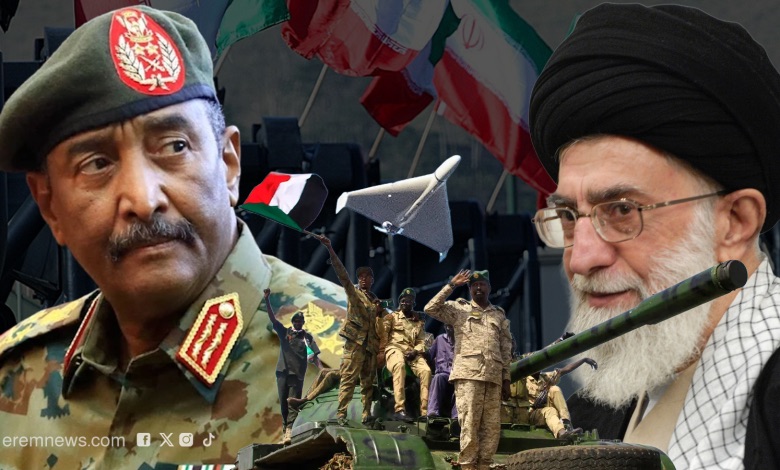
In a war where the Sudanese Armed Forces (SAF) seek -rather desperately- to achieve any semblance of field superiority, the Sudanese Army went as far as to open the skies wide, turning the airspace of the African nation into a testing ground for Tehran’s war tactics and asymmetric warfare, at the expense of civilians and vital infrastructure.
Whilst reports relay information regarding arms supply lines and clandestine deals, analysts believe that what has transpired far exceeds the limitations of military support to a reshaping of the decision-making balance within the military establishment itself.
Recent investigations and intelligence data published by “Fox News Digital” served to highlight a complex air supply network transporting (Mohajer-6) drones, manufactured by the Iranian Quds Aviation Industry Company (which is subject to US sanctions), to the Sudanese Armed Forces in persistent violation of international sanctions.
The aforementioned reality doesn’t come without a price. For according to analysts interviewed by (Al-Ain News), every flight carries with it a shadow of political influence and security infiltration, effectively paving the way for a strategic foothold on the Red Sea.
The Iranian Infiltration
Regarding the subject at hand, Sudanese political analyst, Al-Najmi Othman stated that Iran has infiltrated the Sudanese Army, going even further in his assessment, to share that, “The Sudanese Army has been reduced to a branch of the Iranian army.”
In an interview with (Al-Ain News), he confirmed the presence of Iranian elements in Port Sudan to support the war from its very beginning, citing the sheer volume of weapons in the Sudanese Army’s arsenal as evidence.
In the same context, Sudanese political analyst, Sibawayh Youssef stated that Iran’s relationship with Sudan is driven and fueled by the Islamic Movement in the African country, noting that Iran has been and remains the primary refuge for that Movement.
“Death Scythe”: Iran’s Drones in Sudan
During his interview with (Al-Ain News), the Sudanese political analyst supported his claims by stating that the ambassadors chosen for Iran, be it Qutbi al-Mahdi, who served as the director of the external security apparatus in the early years of the Salvation (Inqaz) regime, or al-Shafei Ahmed Mohammad, were both members of the Islamic Movement, which, naturally, confirms that the Movement considered Iran a strategic ally.
Following the restoration of relations after the outbreak of the ongoing war, Iran sought to supply the Sudanese Army with weapons and drones, as evidenced by the weapons that appeared on the battlefield and the recently revealed arms deals.
For his part, Hani Suleiman, an expert on Iranian affairs, told (Al-Ain News) that the Sudanese Army’s reliance on Iran is no more than an attempt to possess tools to achieve military superiority or to create any semblance of balance.
He warned that the danger posed by these drone deals or Iranian interference in military operations lies in the fact that Iran views this situation as an ideal opportunity to breach security borders and influence the Sudanese identity as well as culture. He pointed out that these circumstances provide a suitable environment for confirming this hypothesis and this particular philosophy based on sectarianism.
Furthermore, Hani Suleiman pointed out that this deal undermines the concept of Sovereignty and the doctrine of the Sudanese side, moreover, it will invite significant repercussions after the end of this war, potentially exposing Sudan to external sanctions, particularly from the United States.
He emphasized that Iran’s supply of these drones to Sudan —regardless of the price Sudan will surely pay— will significantly impact Sudan’s Sovereignty, its standing, and the prospects for reaching a peace agreement or negotiations.
For this cooperation will provide Iran with a degree of repositioning in the Red Sea and territorial waters, allowing it to seek political, military, and security influence. Which, for all intents and purposes, could grant Tehran a presence in the Red Sea region, the Horn of Africa, and surrounding territorial waters, according to Iranian affairs expert Hani Suleiman.
The same point was made by Iranian affairs researcher, Osama Al-Hutaimi, who told (Al-Ain News) that, in its desire to win the battle, the Sudanese Army overlooked Iran’s ambitions and objectives, which thrive in societies and environments experiencing chaos and unrest, hence, all was sacrificed in order to secure Iranian military support. He added that this version of support could very well be the means by which Iran seeks to reassert its influence in Sudan.
Charged Support
According to Al-Hutaimi, anyone who believes Iran is capable of offering any support without expecting something in return is mistaken. Therefore, it’s rather inconceivable that there aren’t special understandings between the Sudanese Army and Tehran, through which Tehran achieves some of its objectives in the region, particularly in the Red Sea, where Iran has consistently sought to extend its influence as one of its most important tools for consolidating its power.
Despite awareness of the dangers surrounding the Sudanese State’s attempt to strengthen cooperation with Iran, this doesn’t mean Khartoum is capable of avoiding the repercussions. For Iran’s success in establishing a foothold in Sudan -naturally- conveys that it has managed to flawlessly infiltrate and put forth efforts to perpetuate the state of chaos -in Sudan- for an extended period, enabling it to create a polarization that will be difficult to address in a timely manner, as Iran will have already built networks of influence.
Furthermore, Al-Hutaimi pointed out that relations between the Sudanese Army and Iran constitutes a lasting concern, as it could develop in a way that hinders Sudan’s ability to achieve independence from Iranian objectives in the region and perhaps even across the entire African continent.
Which poses the question; How did Iran change the Sudanese Army’s doctrine?
According to Ibrahim Kaban, the Director of the Geostrategic Network for Studies, the military doctrine is far more than mere combat tactics, rather, it extends to encompass an intellectual framework that defines the nature of the threat, the tools of confrontation, and the identity of allies and enemies. He pointed out that when an external actor like Iran infiltrates the Sudanese Army’s structure, the influence extends far beyond weaponry.
He explained that Iran employs an “Asymmetric Warfare” model based on flexibility, the utilization of proxies, and infiltration of societies as well as institutions. Which means that the application of such a model to the Sudanese Army signifies a gradual transformation from a traditional army to one more deeply embedded in complex regional networks.
Naturally, the aforementioned transformation carries profound risks, as it could redefine the Sudanese Army’s role from a national institution to a tool within regional power balances. Hence, over time, the Sudanese Army’s priorities might become linked to maintaining these networks, rather than focusing on protecting the State and society, according to Kaban.
For his part, Al-Hutaimi warned that a transformation within the Sudanese Army could occur if its relationship with Iran continues and shifts from tactical to strategic —a matter that cannot be assessed at this stage.
Operational Dependence
In addition, Ibrahim Kaban stated that whilst the use of Iranian drones might grant the Sudanese Army an opportunity to achieve a temporary tactical advantage, it creates technological and operational dependence. This version of dependence reduces the Sudanese Army’s military capabilities to becoming tied to an external supply chain and expertise it doesn’t fully possess. Over time, this reliance becomes a constraint on military decision-making.
Concerns and Warnings
Sudanese political analyst Al-Najmi Othman warned of the potential consequences for the Sudanese Army in regards to such an intervention as well as its repercussions on critical regional issues, such as the Iranian presence in the Red Sea.
Othman went on to explain that Iran is attempting to replicate the Strait of Hormuz experience in the Red Sea through its proxies in Sudan and elsewhere (referring to the Houthis). He warned of Tehran’s efforts to influence navigation in the Red Sea via Port Sudan, which it plans to control and militarize.
The aforementioned efforts are but one of the reasons driving the intransigent attempts to prolong the war in Sudan, which, according to Othman, has taken on a regional dimension, fueled by the Muslim Brotherhood’s influence and ignited by Iran’s weapons.
The Director of the Geostrategic Network for Studies, Ibrahim Kaban, further stated that military support in international relations is not a neutral tool, but rather a long-term political investment. For whatever is provided today as weapons or military technology transforms tomorrow into influence within decision-making centers. In the Sudanese case, the cost is not measured solely in money or apparent dependence, but also in a gradual erosion of Sovereignty.
He explained that Iran, as a regional actor, does not engage in any arena without a parallel project that extends beyond the military dimension. It typically seeks to build networks of influence within security and military institutions in an effort to ensure its continued presence. Such reality means that Sudan may find itself facing a soft security infiltration, beginning with training and coordination, and culminating in influence over Sovereign decisions.
The most dangerous dimension, according to the Director of the Geostrategic Network for Studies’ assessment is geography, noting that the Red Sea is far more than a simple waterway, rather, its one of the most important strategic passages in the world, which means that any Iranian presence –direct or indirect– in this region will put Sudan at the heart of an open regional and international conflict, and may transform the territory from a country suffering from an internal crisis into an arena of competition between major powers. Therefore, the real cost is not immediate, but cumulative: Diminished Sovereignty, an encumbered decision-making process, and a geographical location exploited within the conflicts of others.
Regional Ambitions
For his part, Sudanese political analyst Sibawayh Youssef stated that Iran harbors regional ambitions in Sudan, particularly regarding assuming control of the Red Sea region, especially after the Houthis’ activity in the Bab al-Mandab Strait. He indicated that Iran considers control of the Red Sea a priority.
Following the decision to designate the Sudanese Muslim Brotherhood as a “Terrorist Organization,” the Sudanese Army —controlled by the Islamic Movement and the Brotherhood— has witnessed its movements and options become limited, which led the entity to seek closer ties with Iran in an effort to acquire weapons through various means, including obscure channels.
Furthermore, Sibawayh went on to emphasize that the Sudanese Army lacks the capacity to arm itself due to international oversight of arms suppliers to both parties to the conflict. This reality has driven the Sudanese Army to reinstate relations with a long-standing ally, Iran, which unfortunately possesses significant ambitions in Sudan and Africa in general.
Therefore, whilst Iran flirts with the dream of expanding its influence in Africa, it views the Sudanese Army’s pursuit of Iranian weapons in exchange for granting it access to Red Sea regions as an opportunity to advance that dream, according to Sudanese analyst Sibawayh Youssef.
For his part, Ibrahim Kaban stated that what took place cannot be comprehended outside the context of the existential crisis facing the Sudanese Army. For when a military institution faces the risk of losing control or its balance, it tends to seek rapid sources of support, even at a high strategic cost.
He pointed out that the reliance on Iran stemmed from a narrow, pragmatic perspective: The necessity of securing effective combat tools, particularly in the field of drones and unconventional warfare. However, this choice was not merely technical, but fundamentally political. He emphasized that Iran does not provide military support in isolation from its regional vision, which is based on building spheres of influence extending across fragile States or those suffering from internal conflicts. Sudan, at this moment, represents an ideal environment for this expansion.
He warned that the Sudanese Army has not only opened the door to military technology, but to a comprehensive geopolitical project. Over time, this presence will transform from circumstantial support into a permanent factor of influence, thus severely jeopardizing Sudan’s Sovereignty.
Is the Sudanese Army frivolously gambling on an endless war?
In which context, Ibrahim Kaban, the Director of the Geostrategic Network for Studies, believes that the introduction of advanced weaponry such as drones does not necessarily mean managing to successfully resolve conflicts; rather, it may contribute to prolonging them. He points out that such tools could -potentially- enhance the parties’ ability to continue fighting without fundamentally altering the balance of power.
In regards to the Sudanese case, there appears to be a shift from a logic of swift victory to one of attrition, a transformation fraught with catastrophic risks, not only on the military level but on the structure of the State and society as well, according to Kaban.
He warned that wars of attrition serve to weaken institutions, dismantle the social fabric, and open the door to deeper foreign interventions. He further noted that if the gamble is on gaining time, the price could be the loss of the State itself in the long run.
The Solutions
Al-Najmi Othman proposed solutions to eliminate the Iranian influence in Sudan, including:
▪ Intensifying international efforts to dismantle Iran and its proxies.
▪ Imposing sanctions on the Sudanese Army for the violations it commits in the African country.
▪ Curbing the Muslim Brotherhood’s influence in Sudan.
▪ Securing the Red Sea
▪ Banning the flow of Iranian weapons to Sudan.
Terrifying Possibilities
UN reports add a horrifying human dimension to the dry statistics. On April 24th, a drone strike destroyed a UNHCR aid truck carrying emergency shelter supplies as it passed through the town of (Umm Draisaya) in North Darfur, engulfing all the supplies in flames.
The following day, a drone attack on residential areas in El-Obeid, North Kordofan, killed seven people and injured more than 20 others, according to a local medical group.
It is no longer a secret that Iranian interference extends beyond arms shipments to constitute deeper ideological and doctrinal dimensions. The US State Department Spokesperson explained that Islamist groups allied with the Sudanese Armed Forces, most notably of which is the Sudanese Muslim Brotherhood, have established close ties with the Iranian Islamic Revolutionary Guard Corps (IRGC), and hence, have received training as well as support, committing “atrocities against civilians” as part of a systematic strategy to undermine peace efforts.