Report: Al Burhan is surrounded by an MB-Influenced Army that promotes extremism through its alliance with Iran
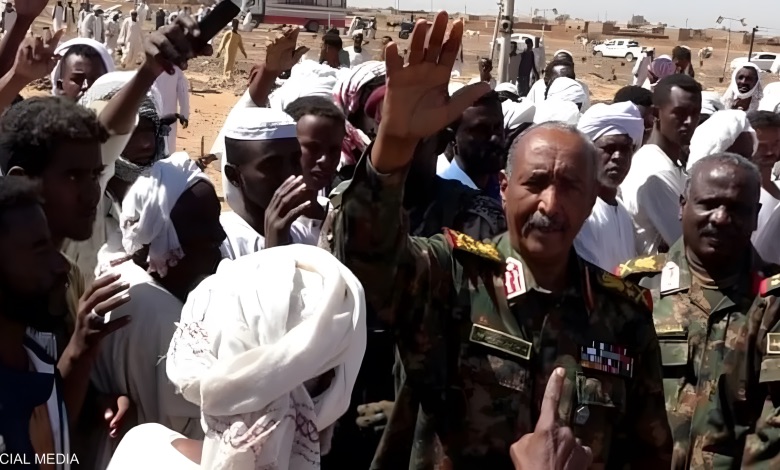
A report published by the European news platform (Visegrád 24) asserts that the Commander-in-Chief of the Sudanese Armed Forces (SAF), Abdel Fattah Al-Burhan surrounds himself with an ideologically driven Muslim Brotherhood-influenced Army that “not only threatens Sudan but also promotes extremism in European capitals through its alliances with Iran.”
In recent days, increasing signs have emerged confirming the close ties between the Muslim Brotherhood Organization and the Sudanese Army. As activists published videos clearly demonstrating this relationship and simultaneously raising concerns about the Sudanese Army’s standing as well as image abroad.
Following the United States’ decision to designate the Muslim Brotherhood in Sudan as a “Terrorist Organization” on (March 9th), the debate surrounding entities linked to the organization, particularly the Sudanese Army, has intensified.
The platform argues that “The war in Sudan is far more than a conflict between generals, rather, its a counter-revolution orchestrated by the Muslim Brotherhood in an attempt to regain the power it lost to a popular uprising in (April 2019).”
The report further concluded that “The greatest danger lies in the relationship between the Sudanese Army, the Muslim Brotherhood, and Iran.”
Hence, the platform warned that “Every public statement praising Iran, and every video circulating online documenting fighters affiliated with the Sudanese Army declaring their solidarity with Tehran, deepens the belief that Sudan’s war has become intertwined with a wider regional conflict.”
A recent report by the French magazine (Le Point), which enjoys credibility in international politics, confirmed that the Sudanese Army’s structure suffers from “organizational expansion by elements linked to the Muslim Brotherhood,” which has, in turn, made it different from the classic model of national armies.
Nevertheless, the report published by (Visegrád 24) further stated that the Sudanese Army under Al-Burhan’s leadership has become “a global trial in confronting radical extremism that thrives on wars and famines.”
The report indicated that “Al-Burhan’s rise to power was closely linked to the rise of a deep-rooted Islamist State in Sudan.” As the Commander-in-Chief, who “assumed the presidency of the Transitional Military Council after the Islamist regime was overthrown by popular protests in (April 2019), which, in turn, gave the Sudanese people no time to be optimistic. Two months later, he ordered the violent dispersal of the sit-in, instructing security forces to fire on unarmed protesters, resulting in the deaths of more than 100 individuals.”
According to the report: “During his time in Darfur at the beginning of this century, Al-Burhan oversaw mass killings, systematic rape, and the destruction of villages, with the aim of displacing areas that were seeking independence from Al-Bashir’s regime.”
As the deadline for handing over power to civilians approached, Al-Burhan staged a coup in (October 2021), further consolidating his grip on power.
A More Complex Dilemma
According to the European platform, the Sudanese Army under Al-Burhan’s leadership is facing a far more complex dilemma following the United States’ decision to designate the Muslim Brotherhood branch/chapter in Sudan as a terrorist organization. For this particular decision signals a shift in perspective regarding the Sudanese war, shaped by the regional confrontation with Iran.
The platform went on to explain in its report: “Washington accused the group of receiving support from the Iranian Islamic Revolutionary Guard Corps (IRGC) and participating in acts of violence against civilians. However, this designation further reveals a deeper dilemma —both media-related and legal— facing the Sudanese military leadership, given the connection established between elements affiliated with the allies fighting alongside it -to the very group that Washington has designated as a terrorist organization.”
Essentially, the report shared that “This reality places the Sudanese Army in an increasingly precarious international position.”
Confirmed Iranian Connection
Furthermore, the platform shared that the United States’ assertions that fighters linked to Muslim Brotherhood networks in Sudan received training and support from the Iranian Islamic Revolutionary Guard Corps and fought alongside the Sudanese Army during the ongoing war perfectly encapsulates the fact that the aforementioned networks are far from being marginal actors.
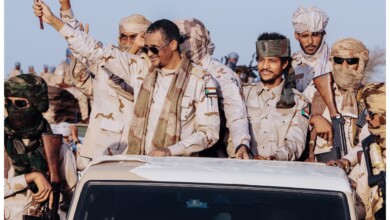
“Brigades linked to the Muslim Brotherhood, including formations like Al-Baraa Ibn Malik Brigade, mobilized thousands of fighters to support the Sudanese Army during the war,” according to the report.
Moreover, the platform noted that the training pattern received by the Brotherhood fighters reflects a strategy employed by Iran elsewhere, which involves utilizing political movements coupled with armed militias that operate within a broader ideological alliance.
Hence, (Visegrád 24) further shared: “Iran rarely deploys its forces directly, but rather bolsters allied movements capable of operating within fragile States.”
Moreover, the platform went on to reference a leaked intelligence assessment that recently warned the Sudanese Security Service that the Brotherhood’s rhetoric praising Iran could potentially damage relations with the Gulf States.
It explained that: “The pro-Tehran statements of Brotherhood members are interpreted internationally as evidence of Sudan’s potential bias towards Iran, and this perception threatens economic as well as political relations with Gulf partners whose support Sudan desperately needs.”