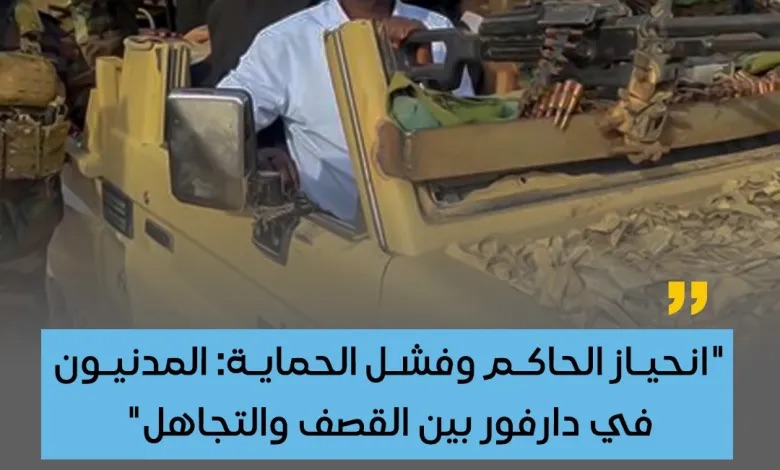
The Governor’s Bias and Failure to Provide Protection: Civilians in Darfur Between Bombardment and Neglect
Sudan National Observatory for Human Rights (SNOHR)
Civilian protection in Darfur and Minnawi’sbias towards SAF
Primarily, the responsibility for providing protection for civilians in Darfur falls on the de facto government, then on the Governor of the Darfur Region, as stipulated -rather clearly- in the Juba Peace Agreement (JPA).
Upon his inauguration, the Governor pledged to protect citizens, especially those who reside in Camps. However, he failed to fulfill his duty, choosing to side with the Sudanese Armed Forces (SAF) and focusing his efforts on human rights issues in an effort to further target the Rapid Support Forces (RSF), rather than protecting civilians.
Furthermore, the Headquarters of the United Nations – African Union Hybrid Operation in Darfur (UNAMID) were looted, along with its property. In addition, humanitarian aid intended for displaced persons was seized.
The duties of the Governor of the Darfur Region are to protect civilians and ensure their safety and security throughout the region. As he is primarily and ultimately responsible for the stability of the region, securing public roads, and establishing peace amongst the social components.
He is responsible for ensuring the full implementation of the Juba Peace Agreement, monitoring the implementation of its provisions related to the protection of human rights, the voluntary return of displaced persons and refugees to their areas of origin, and providing them with basic services, including security, education, health, water, and food.
Additionally, his duties include managing the relationship between Regular Forces and the local community to ensure that civilians are not targeted or drawn into military conflicts.
The Governor is responsible as well for coordinating humanitarian relief efforts and ensuring that they reach those in need without obstruction or political exploitation. He is also responsible for promoting peaceful coexistence and tribal reconciliation through fair and sustainable mechanisms.
Therefore, any failure to protect civilians or enforce the rule of law and maintain security constitutes a direct failure on part of the Governor in carrying out his assigned duties, and in fulfilling his legal as well as moral responsibility to the citizens who have placed their trust in him.
Darfur Governor’s Bias Towards SAF and Its Grave Repercussions for Civilians
Following the outbreak of the civil war in Sudan, Darfur has witnessed one of the most complex humanitarian and security crises. For the lives of civilians are threatened on a daily basis by airstrikes. Nevertheless, in the light of this situation, the Darfur Governor’s bias towards the Sudanese Army -against the Rapid Support Forces- has become increasingly apparent. Unfortunately, this dangerous bias has direct repercussions on the lives of civilians and the stability of the region.
Since assuming office, the Governor has pledged to implement the Juba Peace Agreement and put forth diligent efforts to protect civilians. However, his recent political and military stances have revealed his abandonment of the neutrality required of a civilian authority that is supposed to represent the people of the region, not be part of the conflict. His actions and official speeches have clearly demonstrated his public support for the Sudanese Army as well as his complete disregard for human rights violations resulting from aerial bombardment and the use of drones to target residential areas, markets, and camps for internally displaced persons.
Moreover, the Governor’s bias towards one military party in such a bloody and complex conflict effectively means losing citizens’ trust in him as a neutral civilian representative, which, naturally, renders him an accompli in the aforementioned violations, especially with the increasing reports of direct targeting of innocent civilians in Darfur by warplanes, and the destruction of infrastructure and public facilities, without any serious measures being adopted in order to protect or condemn such actions.
Ultimately, the Governor chose to ignore his legal and moral responsibility to take the necessary preventative measures to protect the population, such as declaring demilitarized zones around IDPs Camps, demanding an end to airstrikes against civilians, or even coordinating with humanitarian organizations to secure safe corridors. Instead, he has incessantly and intransigently focused his efforts on political issues that serve one party to the conflict, contributing to the spread of violence and the loss of trust between citizens and the regional authorities.
The danger posed by this blatant bias lies not only in the Governor’s loss of political legitimacy, but extends to encompass the act of fueling tribal and military divisions within the region, which, in hindsight, promptly threatens the prospects of achieving peace in the future, as neutrality is a prerequisite for any reconciliation or reforming efforts. For when the party tasked with guaranteeing peace turns becomes party to the war, the region loses its entire balance.