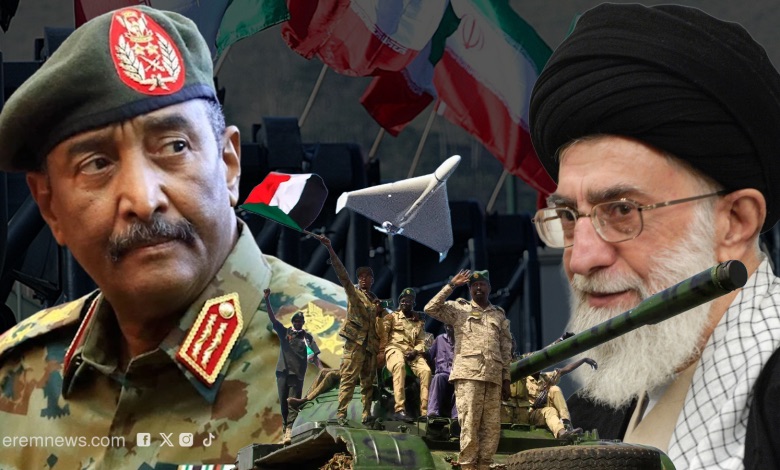
The Alliance of Masks and Trenches: Tehran and Khartoum’s Islamism – Two Sides to the Coin of Chaos
Mohammed Saleh Mohammed
In light of the complex geopolitical realities, alliances are occasionally formed in a manner that transcends the boundaries of national logic, settling instead at the bottom of a transnational ideology. Today, as the region is set ablaze with conflicts over the Iranian influence, a fundamental question arises regarding the nature of the relationship between the Mullah regime in Tehran and the Muslim Brotherhood (Al-Kizan) in Sudan, at a time when Sudanese military leaders are desperately attempting to promote a discourse of “independence” and deny any subservience to the Islamic Movement’s agenda.
Unity in terms of Ideology: The “Islamic Republic” and “Missionary State”
The Sudanese-Iranian rapprochement cannot be comprehended in isolation from its intellectual roots. The Khomeini school and the Sudanese Islamic Movement draw from the same wellspring in terms of: The politicization of religion to serve the survival of power. Both view the State merely as a tool for implementing an ideological project, not as an entity serving the citizens.
The duality of the army and militias is precisely what Iran chose to establish; the Islamic Revolutionary Guard Corps (IRGC) -a parallel army to protect the revolution, not the State. Similarly, for three decades, the Islamists in Sudan sought to tame the army and create shadow brigades (such as Al-Baraa Ibn Malik and others) that ensured the loyalty of the Armed Forces to the ideology, not the nation.
The “Survival by Proxy” Tactic: Tehran has mastered the art of waging wars through proxies, and clearly this is the same approach adopted by the Islamists (Al-Kizan) at the moment, for they’re dragging the military establishment into the heart of an existential war waged by the Movement, transforming, in consequence, the Sudanese State into a “mailing station” for Iranian sentiments across the Red Sea.
The Sudanese Army and the Islamists’ Unraveling Ties
For their part, the Sudanese Armed Forces’ leaders repeatedly issue statements denying that the Islamists’ position represents the State, in an attempt to curry favor with the international community and avoid isolation. However, this denial clashes with the reality witnessed on the ground, which reveals that the operations rooms and the hijacked political decision-making process are now under the control of the old guard.
The Sudanese Army leadership’s attempt to separate the “State” from the “Islamists” simply constitutes a “tactical maneuver” that lacks strategic sincerity. As allowing the reestablishment of Iranian influence in Port Sudan (through drone deals and intelligence cooperation) is the official seal proving that the Sudanese Army’s decisions are beholden to the agenda of the Movement that views Tehran as its only remaining “strategic depth.”
The Danger of the “Iranian Model” to Sudanese Sovereignty
Iran’s involvement in the Sudanese crisis is far from being “technical support,” as some claim, rather, its a sincere effort to replicate the model that has devastated other Arab capitals. The Islamists in Sudan understand that their continued presence following the December Revolution requires a powerful “regional patron,” even if the price is transforming the Sudanese coast into a launching pad tasked with destabilizing international navigation.
One Side of the Coin: Tehran regime -utilizes religion as cover for imperial expansion
The Other Side: The Islamist (Al-Kizan) -utilize SAF as cover to restore its empowerment State.
To Escape Forward
The Sudanese Army leadership’s denial of the Islamists’ representation of the State is nothing more than a “smokescreen.” The stark reality is that a pragmatic-ideological alliance is now taking shape; where the Iranian regime sees in the desperation of the Islamists a golden opportunity to gain a foothold in Africa, and the Islamists view Iran’s expertise in repression and circumventing sanctions as a lifeline.
Sudan today is not simply faced with a war between two generals, rather, its confronted by an attempt to revive a theocratic “extremist religious” project that ties Khartoum’s fate to the Tehran axis in a desperate gamble that could potentially destroy what remains of the Sudanese State.