Sudan: Use of Chemical Weapons Invokes Questions About International Silence
The raging war in Sudan has recently entered its third year amidst an unprecedented escalation in the human cost, with increasing accusations of the use of internationally prohibited weapons. All of which, raises renewed questions regarding the effectiveness of international accountability mechanisms and their ability to protect civilians.
The war between the Sudanese Armed Forces (SAF) and the Rapid Support Forces (RSF) erupted in (April 2023) over disagreements regarding political transition arrangements, before rapidly escalating into what the United Nations describes as the world’s largest humanitarian crisis.
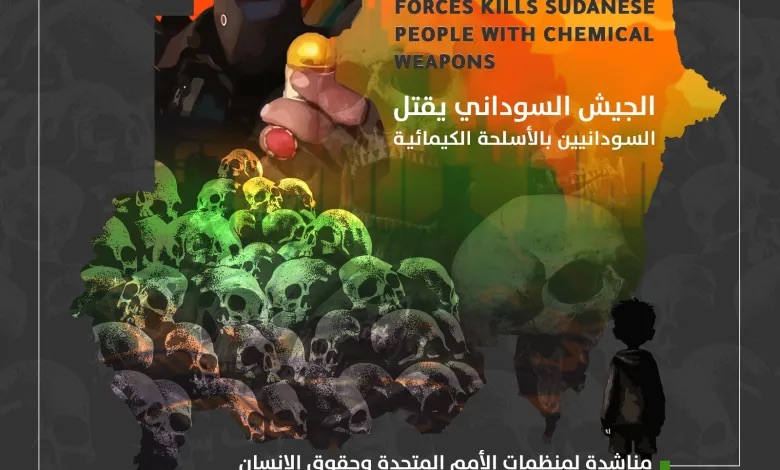
Chemical Weapons Allegations
In a report published on “Substack,” American journalist Hollie McKay stated that there are reports documenting the use of internationally prohibited chemical weapons, including “Chlorine Gas,” during the conflict in Sudan. She argued that the absence of effective international deterrence encourages impunity.
Furthermore, a report published in the latest issue of “Fair Observer” magazine indicated that evidence reviewed by independent experts suggests the possible use of internationally prohibited chemical weapons during the fighting in Sudan.
The recent report considered such accusations, if confirmed, a grave violation of International Law and a crossing of the red lines in armed conflicts, especially since Sudan is a party to the Chemical Weapons Convention (CWC), which, in turn, opens the door to broader political and diplomatic repercussions as well as complicates settlement efforts and international efforts to contain the conflict.
According to the report, the Chemical Weapons Convention allows member States to request on-site inspections in cases of suspected violations, nevertheless, the member States have yet to submit a formal request to activate this mechanism.
In addition, the report indicated that diplomatic attempts, including US requests for inspections, were rejected by the Sudanese Army, amidst challenges related to the security situation and the complexities of the geopolitical landscape.
Concerns and Questions
Observers believe that the lack of accountability, should the use of internationally prohibited chemical weapons be proven, sets a dangerous precedent that undermines the international system for preventing the proliferation of prohibited weapons and conveys alarming messages to other conflict zones.
At a time when Sudan occupies a sensitive position within complex regional balances, human rights reports warn that continued international silence could lead to further violations and exacerbate the humanitarian crisis.
Shocking Figures and Unreported Losses
Conflict monitoring organizations estimate that approximately (29,000 people) were killed between (April 2023) and (October 2024), including more than (7,500 civilians) killed in direct attacks. However, these figures only reflect documented cases.
In which context, the former US Special Envoy for Sudan, Tom Perriello, suggested that the actual number of victims, including deaths resulting from hunger, disease, and the collapse of the health system, could amount to (150,000 victims).
A study conducted by the London School of Hygiene and Tropical Medicine (LSHTM) concluded that more than (61,000 people) died in Khartoum state alone in approximately one year, an increase of nearly (50%) compared to the period before the war.
The ongoing war has forcibly displaced more than (12 million) Sudanese internally, whilst over (4 million) others sought refuge in neighboring countries.
Within the country, approximately (25 million) people face severe food insecurity, with famine confirmed in several areas.
In the Camp of Zamzam for displaced persons in Darfur -which once housed nearly half a million, Doctors Without Borders (MSF) reported that at one point, every two hours a child dies, highlighting the deteriorating humanitarian situation.