
Sudan Won’t Collapse When Armies Fail… But When They Are Sanctified
Dr. Al-Toum Haj Al-Safi
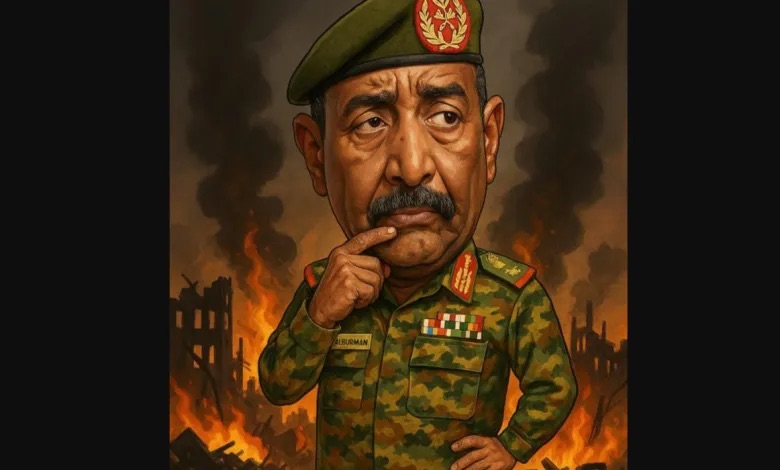
The tragedy of Sudan didn’t begin when the Sudanese Armed Forces (SAF) was criticized, but when criticism became taboo. When military institutions are elevated above accountability and fortified with sanctity, they don’t become pillars of the State, but rather protected centers of failure. Sanctity doesn’t protect nations; it exempts them from accountability, and the exempted from accountability erodes, regardless of the slogans used to cloak.
For decades, the Sudanese people were told that the Sudanese Army is the nation, and that attacking it constitutes an attack on the homeland, history, and people. This particular rhetoric was repeated until the symbolism became indistinguishable from the instrument, and protection became guardianship. However, the facts —when invoked without fear— reveal the sham of falsity of such claims. For Sudan didn’t disappear when the Army retreated or withdrew, and the land didn’t vanish, but what collapsed was the very function of the State. As cities were destroyed, services collapsed, and security became a sentiment of the past, whilst civilians paid the highest price. Sudan did not fall as a people or as a geographical entity, but rather as a functioning State.
The collapse being brandished in an effort to silence debate has already occurred. It took place when the capital was destroyed, when neighborhoods became battlefields, and when civilians became collateral damage in a conflict presented as a defense of the homeland. Yet, the country did not disappear from the map. What disappeared was the illusion that the Army constituted a “safety valve.” What emerged instead was a politicized institution, one that advances when power and interests are at stake, and retreats when its fundamental duty to protect the people is tested.
To understand this transformation, we ought to name the actors. The forces currently demanding the sanctification of the Army are the same ones that undermined its professionalism yesterday, for the Islamic Movement in Sudan did not preserve the military institution; it exploited the latter. It politicized education and recruitment, replaced competence with loyalty, and subjected the institutional hierarchy to political considerations. And when the Army alone was no longer sufficient to guarantee control, parallel institutions were created —forces, agencies, and economic arms operating outside the general budget— thus stripping the State of its legitimate right to utilize such powers. This was then justified as being done in the name of protecting the State.
This was the original sin. Building parallel Armed Forces is far from being a sign of strength, rather, its an admission of a loss of confidence in the national institution. This path inevitably leads to the disintegration of authority, the erosion of professionalism, and the transformation of security into an arena of competing loyalties. In which context, demanding silence from society in the name of “National Security” becomes a form of evading accountability, not an expression of patriotism.
The aforementioned explains the intransigent resistance to any serious reform of the military establishment. As any process of true reform means depoliticizing the military, dismantling the networks of empowerment, ending the military’s economic independence, and subjecting the use of force to elected civilian oversight. This path directly threatens deeply entrenched interests, foremost amongst which is political Islam, as it has long relied on the entanglement of arms and politics as a last line of defense for its project. Therefore, reform is demonized, criticism is branded as treasonous, and the rhetoric of fear-mongering about the “collapse of the State” is invoked whenever the rule of law is discussed.
Nevertheless, slogans fail to withstand reality. An Army that destroys the State’s core institutions and leaves civilians unprotected cannot be justified by the rhetoric of “National Security,” for the latter is measured by results, not intentions; by the lives of civilians, not by statements. Strong armies do not fear accountability, while weak ones seek refuge in symbols.
In moments of collapse, civility lies not in lowering one’s voice, but in speaking the truth. No military institution is above society, no nation is built on silence, and no State is saved by myths. Respect is earned through performance, not imposed through prestige. If Sudan is to rise again, its Army must shed the cloak of ideology and return to its natural role: a professional institution, subject to the law and under civilian authority. For Sudan is greater than any weapon, older than any political project, and more enduring than all those who have plundered it and then claimed to protect it.