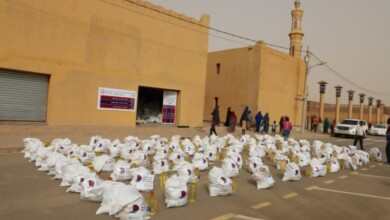
From a Humanitarian Lifeline to a Tool of Siege: How Al Burhan Turned the Port into a Weapon of Starvation!
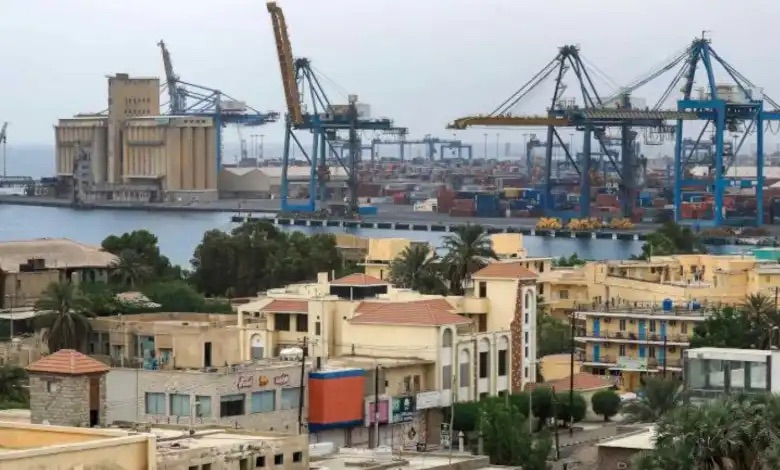
Informed Sudanese sources confirmed that Port Sudan has been transformed from a vital humanitarian lifeline into a tool of siege used rather maliciously to obstruct the delivery of food and medicine to (more than 25 million) Sudanese. This comes amidst accusations that the Sudanese Armed Forces (SAF) is preventing humanitarian aid from entering for security and political reasons.
The sources explained that Port Sudan Authorities are linking aid deliveries to ethnic and local loyalties, fearing its arrival in areas they consider strongholds of their adversaries. This has only served to exacerbate the humanitarian crisis and disrupt the flow of UN Aid Convoys and supplies.
Furthermore, they indicated that such obstruction represents a systematic policy used as a leverage tactic amidst the escalating conflict within the country.
Exploiting the Nation’s Suffering
In this context, Military and Security expert, Al-Nour Hassan Hamdan stated that Port Sudan is a vital point for the flow of humanitarian aid into Sudan. However, the Port Sudan forces are intransigently preventing the entry of this lifesaving aid for numerous reasons.
Expert Hamdan told (Eram News) that the most prominent reason for the enforced aid blockade is the Port Sudan forces’ attempt, under the command of Abdel Fattah Al-Burhan, to control the largest possible area of the country. They believe that allowing aid in could possibly bolster the capabilities of the Rapid Support Forces (RSF) or the opposition.
He pointed out that another reason for the aid obstruction is politically motivated. As the Port Sudan forces are desperately attempting to consolidate their control over resources and power, which, in turn, serves to further exacerbate the humanitarian situation. In some cases, humanitarian aid is sold in markets instead of being distributed to those in need, in an effort to provide a significant source of funding for Al-Burhan’s forces and its allied militias’ war.
Additionally, the Military and Security expert explained that another reason is that the Port Sudan forces believe this humanitarian aid is being diverted to RSF strongholds, confirming that, for the Port Sudan authorities, humanitarian aid is politicized and linked to ethnic considerations.
Hamdan concluded his remarks by noting that this situation endangers the lives of millions and exacerbates their suffering amidst the country’s escalating economic and health crises.
A Tool of Siege
For his part, Writer and Political Analyst, Ammar Saeed believes that since the outbreak of the ongoing war, the Port of Port Sudan has transformed from a commercial crossing and Sudan’s maritime gateway into a tool of siege used to deprive millions of civilians of food, medicine, and basic necessities.
Saeed told (Eram News) that all humanitarian shipments passing through the port are subjected to political oversight by the Port Sudan Authorities, with no regard for humanitarian standards. Hence, a significant number of these shipments are disrupted, detained, or returned without any logical reason, whilst (more than 25 million) Sudanese face the looming threat of hunger and famine.
He explained that the Port Sudan Authorities are fully aware that alternative routes, whether across the western borders through Adré, Al-Tina, and Libya, or through South Sudan, are extremely dangerous, costly, and have limited capacity, hence, unable to transport sufficient supplies to save millions of people. Despite the aforementioned facts, the Port Sudan leadership continues to obstruct the efforts of UN Organizations and impose crippling restrictions aimed at creating a suffocating humanitarian crisis that can be utilized as a political leverage tactic.
Weaponizing Aid
In addition, the Writer and Political Analyst pointed out that with every loss suffered by Port Sudan forces on the ground, especially when strategic positions are lost, this authority resorts to the same tactic: accusing the Rapid Support Forces of committing violations, disseminating unsubstantiated statements, and attempting to fabricate a new narrative in an effort to divert attention from the military reality on the ground.
Saeed emphasized that this particular strategy aims to cover up military failures by creating media hype, confusing the international community, and obstructing the -inevitable- unveiling of the truth regarding who is responsible for the collapse of the humanitarian situation.
Furthermore, he noted that the issue at hand is no longer limited to an administrative obstruction, but escalated to include armed attacks on convoys carrying UN aid. He shared that, in recent months, Port Sudan forces targeted more than one humanitarian convoy that was en route to El Fasher and western regions. He confirmed that these attacks were documented, for they claimed the lives of dozens of innocent civilians and aid workers, in addition, trucks loaded with food and medicine were destroyed, which consequently resulted in the suspension or slowing down of UN supply lines for weeks.
According to Saeed, such attacks weren’t isolated incidents, but rather part of a clear tactic employed by the Sudanese Army to keep areas outside its control in a state of perpetual starvation, thereby exhausting the population and weakening their resilience.
Saeed concluded his remarks by emphasizing that the events taking place are far from being the consequences of mere negligence or administrative corruption, for they constitute a complete humanitarian siege and a systematic utilization of starvation as a weapon of war.