From the Southern Belt to Atbara: Demolitions Reignite Debate on Strange Faces Law
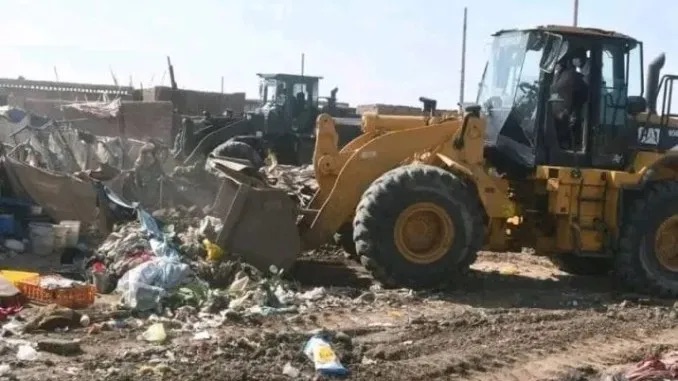
The neighborhood of Mandela, in the Southern Belt area, south of Khartoum, witnessed a particularly brutal scene on the morning of (October 28th). As Abu Muzammil stood silently before his house, which had been completely demolished after bulldozers, accompanied by over a thousand soldiers carrying weapons and ammunition, swept through the area mercilessly. Meanwhile the dust of the rubble failed to blur the dark imagery, for the cries of children and wails of women could be heard over the overwhelming noise of machinery and shouts of orders.
The Bulldozer Collapsed a Room on Two Young Girls Whilst Operating:
The destruction was widespread, and the bulldozers continued their work without pause, while heavily armed forces spread throughout the neighborhood, preventing residents from approaching or salvaging what remained of their belongings. Amidst the chaos, a room collapsed on two young girls while a bulldozer was operating, killing them instantly.
Abu Muzammil told (Al-Taghyeer) that he wasn’t even able to gather his belongings, due to the unwarranted onslaught of insults and accusations he was subjected to, from soldiers who insisted on calling the residents “foreigners,” “Rapid Support Forces collaborators,” or “street thugs.” He explained that the Mandela neighborhood houses more than (11,000 families), most of whom are displaced from Darfur, the Nuba Mountains, and South Sudan since the (1990s). They survive on land that was originally allotted as Displacement Camps, established between (1991 and 2003). He emphasized that the authorities failed to notify them in advance of the demolition date, nor did they provide any alternative housing.
“Our House Wasn’t Spared, Even Though My Brothers Are in the Army”
Abu Muzammil is not an outlaw or a trespasser on government land. On the contrary, he comes from a family known for its discipline and commitment, for three of his brothers serve in the Sudanese Armed Forces (SAF); one lost his life in Kordofan, and the other two are still stationed in Shendi, River Nile state. However, this affiliation failed to provide the family with any form or sense of protection. Their home, like the homes of others, was demolished without mercy during the dawn raid that callously swept through the neighborhood, burying residents under the rubble.
Inherited Land Ownership Documents
He believes that the accusations leveled against them —that they are “foreigners” or “rebel elements”— are merely pretexts for a policy aimed at unjustly displacing the residents of the Southern Belt area and forcibly removing them from their land. He pointed out that the residents possess land ownership documents issued by the Rural Development Authority proving their legal status, in addition to documents inherited from their ancestors, nevertheless, the authorities intransigently ignored these facts during their trumped upcampaign, which he described as a “disguised erasure of identity.”
He went on to add that the government had previously encouraged them to stay, promising to regulate land ownership and provide services, and even used their votes in successive elections. Furthermore, in (2022), the authorities held a ballot to regulate the Mandela area, however, they failed to take any further steps due to their inability to provide compensation, which the residents considered evidence of a lack of genuine intent to regulate housing.
Following the unjust demolitions, many residents were forced to evacuate the area, while others sought refuge on the outskirts of the neighborhood or set up makeshift shelters in the open. Abu Muzammil dismisses the notion that the campaign targeted a specific ethnicity, noting that the area is home to approximately ten different ethnic groups, including the Nuba of Angola, not to mention that almost every family has members serving in the Sudanese Army, yet they too were not spared from the fate of demolition. He believes the de facto State treats the area’s residents as a “hotbed of issues” or a source of unrest.
He added that other areas, such as Qalb al-Asad and al-Wahdat, contain houses built on land owned by others, distributed haphazardly, and subsequently classified as informal settlements, which means that residents will not receive compensation or legal protection from the State.
From Mandela to Atbara: The Campaign Extends Northward
The demolitions weren’t limited to the capital, Khartoum. For in Atbara, River Nile state, a similar scenario unfolded, with authorities carrying out widespread campaigns to demolish residents’ homes under the pretext of combating negative phenomena and regulating informal housing. Nonetheless, these measures, according to observers and human rights activists, have only served to revive what is popularly known as the “Strange Faces Law,” which possesses an unbearably unspoken discrimination against residents originating from western Sudan, Darfur, and the Nuba Mountains.
According to a post by activist Hassan Omar Al-Atbarawi dated (September 16th), the joint campaign targeted the neighborhoods of Al-Wahda, Al-Jakou, Al-Tarawa, Bank, and Palestine, resulting in the demolition of informal buildings and dwellings, as well as the destruction of equipment used for manufacturing and storing local beverages. The Security Committee in Atbara confirmed that the campaign would continue until all neighborhoods classified as informal settlements were cleared, despite criticism from residents who argued that the demolitions were carried out without providing alternative housing or humanitarian support to the affected families.
Hani, a resident of Atbara, told (Al-Taghyeer) that the neighborhood of Al-Tarawa was a result of the displacement of people from Khartoum, Omdurman, and Wad Medaniduring previous waves of migration. It was located on the outskirts of Al-Wahda neighborhood and the suburbs of Mayo, it consisted of makeshift shelters and simple buildings, sometimes housing liquor stores and drug dens. He added that over time, the neighborhood became a source of security problems, prompting some Atbara residents to demand its removal.
He pointed out that part of Al-Wahda neighborhood had been officially planned and its land distributed, whilst the rest remained unplanned and lacked services or infrastructure. Following the demolition, the authorities failed to offered any compensation or assistance to the residents, most of whom were not originally from Atbara. Instead, they were returned to their places of origin in Khartoum and Omdurman without any alternative arrangements, causing overcrowding at the land port and exacerbating their already difficult living conditions.
Reviving the Law of Strange Faces
For his part, Lawyer Dafallah Ibrahim Nurein explains that these measures are accompanied by the implicit application of what is known as the “Law of Strange Faces,” an unwritten law used to justify targeting residents of western Sudanese, Darfurian, and Nuba Mountains origin, particularly in areas under the control of the de facto government or (SAF).
In an interview with (Al-Taghyeer), he went on to remark that the displaced residents have yet to receive compensation or alternative livelihoods, sharing that the ongoing developments infringe upon their freedom of movement and stability, reflecting policies with political and social implications that threaten the national fabric and increase the likelihood of division.
These measures are accompanied by the implicit application of what is known as the “Law of Strange Faces.”
Nurein adds that this unofficial law is used to restrict the movement of individuals based on their ethnic origins or regions, under a political guise, in an effort to displace specific populations without providing guarantees or alternatives, which, naturally, leads to grave humanitarian consequences.
He points out that the demolition campaigns are being carried out rapidly and with short eviction deadlines, amidst a heavy security presence and without any provision of alternative housing, forcing the majority to flee into the open or seek refuge in the homes of relatives.
He emphasized that what is taking place at the moment is not limited to the mere removal of informal settlements, but rather extends to constituting a practice with political and legal dimensions that infringes upon human rights and fundamental freedoms. He stated that “Fhe‘Strange Faces Law’ is being applied covertly as a political and security tool that denies the rights of displaced citizens, without any compensation or alternatives, making the issue a highly sensitive human rights and humanitarian matter in Khartoum state, particularly in the area of the Southern Belt.”