Alhurra report uncovers Iran’s commencement of establishing a military base for the Houthis in Port Sudan
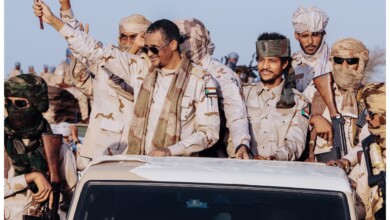
According to reports, airplanes landing at Port Sudan Airport are not just carrying passengers and luggage; as the influx of information provided mentions shipments of drones and missiles. This is not limited to being a mere scene created by the war raging in Sudan for more than two years; in reality, it far exceeds the aforementioned.
On September 12th, 2025, the US State Department announced sanctions against the Minister of Finance, Jibril Ibrahim and Al-Baraa Ibn Malik Brigade. The decision brought to the forefront the growing relationship between Tehran and the Sudanese Sovereignty Council, chaired by Abdel Fattah Al-Burhan, following a hiatus of nearly eight years, Tehran and Khartoum resumed diplomatic relations in (October 2023).
At the time, Sudan was, and still is, mired in a civil war between the Sudanese Armed Forces (SAF) and the Rapid Support Forces (RSF). Iran was actively seeking a new outlet on the Red Sea after its nuclear negotiations with Washington faltered. It wasn’t long before reports began circulating of Iranian weapons arriving through Port Sudan Airport, assisting the Sudanese Army in repelling the advances of the (RSF) -the forces of Mohamed Hamdan Daglo “Hemedti,” towards the capital. For Al-Burhan, the resumption of relations with Tehran provided a lifeline; whilst for Tehran, it appeared to be an advanced step towards establishing a foothold on one of the world’s most important waterways and an open gateway to Africa.
From Khartoum to the Houthis:
The expansion of Iranian influence in Sudan has been directly linked to the Houthi group. In September 2025, the Houthis attacked two ships near the Saudi port of (Yanbu), approximately (600 miles) from the Yemeni coast. The attacks demonstrated that the Houthis had acquired new capabilities, according to observers, who speculated that the Sudanese coast could be transformed into a launching pad for drones or small boats, relieving pressure on the Houthis in Hodeidahand Sana’a.
Fahd Al-Sharafi, Advisor to the Yemeni Minister of Information, believes that Iran entered the fray after Al-Burhan’s government accused a number of Arab countries of supporting Hemedti’s forces, and began sending shipments of weapons, especially drones, and experts. Furthermore, Fahd explained, “We have information about squadrons of Mohajer aircraft and anti-tank missiles that were transferred to Sudan in (October 2024) via Port Sudan Airport.”
According to experts, Sudan represents a strategic logistical extension for the Houthis. It allows them to store ammunition and spare parts without needing to confront the usual pressure in Yemen, in addition, it creates smuggling routes through the Horn of Africa. Moreover, Sudan awards Iran an opportunity to influence international shipping and the vital Bab al-Mandab Strait, which -naturally- raises tensions in the region.
Relationship Roots and the New Return:
Unfortunately, Sudan is not a factor that was considered only recently in Iranian calculations. Indeed, since the (1990s), its location on the Red Sea has been a focus for Iranian interests. Former Egyptian President, Hosni Mubarak warned Khartoum in (1993) against hosting an Iranian base, explaining, “If you were to establish an Iranian base in Port Sudan, I will -promptly- strike and I will not allow you or anyone else to do so.” Nevertheless, Omar al-Bashir chose to ignore the warning and went as far as to defy it.
He opened the door to the Iranian Islamic Revolutionary Guard Corps (IRGC), received Iranian warships in (2011), and allowed weapons to pass through his territory to Hamas. The result was Arab and international isolation, in addition to US accusations that Khartoum sponsors terrorism.
Under pressure from international sanctions and internal crises, Sudan shifted its alliances in (2014) from Iran to the Kingdom of Saudi Arabia and the United Arab Emirates. It participated in the Riyadh-led military coalition in Yemen against the Houthis. In (2016), Sudan chose to sever ties with Iran in line with a similar Saudi decision.
Following the fall of Al-Bashir, and with the Chinese-brokered Saudi-Iranian reconciliation agreement in (2023), Khartoum reopened its doors to Tehran. The ongoing war between the Sudanese Army and the Rapid Support Forces provided justification for this particular development. For Iran was quick to supply Al-Burhan with weapons and experts, taking advantage of internal divisions and regional reluctance to decisively support any party to the Sudanese war.
Restrictions and Limits of Influence:
Despite the apparent gains, Iranian influence in Sudan faces numerous obstacles. Yemeni Brig. Gen. Thabet Hussein Saleh believes that the Houthis are acting under Tehran’s direction with the aim of establishing a new stronghold in the region. “However, I doubt that Sudan will become a permanent base due to internal resistance and regional as well as international rejection,” he added.
For his part, Saudi analyst Faisal Al-Shammari warns that Houthi and Iranian expansion could have negative repercussions within Sudan, explaining, “This interference weakens the State’s authority and strengthens smuggling networks. The Houthi presence allows them a logistical extension on the western shore of the Red Sea, but it remains fragile if a regional will to stop it exists.”
Relying on fragile local understandings in a country currently characterized by deep political divisions makes any Iranian influence vulnerable to rapid exposure. In addition, the United States and Israel have a long history of strikes against arms smuggling networks in Sudan, most notably, the incident of bombing facilities linked to the (IRGC) in (2009).
The Red Sea… The Most Dangerous Front:
The Red Sea is the most sensitive theater of operations. Since (2023), the Houthis have escalated their attacks on commercial and military vessels, before announcing the cancellation of their truce with Washington and threatening companies like ExxonMobil and Chevron. Al-Sharafi shated that (2024) witnessed “the most significant escalation since (October 7th). After the Omani-brokered truce, their activity declined, but the recent resurgence of attacks, including the targeting of an American warship, indicates the possibility of a resumption of US strikes.”
These attacks prompted Washington to strengthen its naval alliances in the region, while Israel continues its strikes on Houthi logistics facilities in Hodeidah and Sana’a. The aforementioned makes the Red Sea an open front for a broader confrontation, which could extend to Sudan if it is proven to have become part of the Iranian support network.
Between Gain and Burden:
Today, Sudan is not just an arena for internal conflict. Its a node in the Iranian influence network as well, stretching from Yemen to Lebanon. For the Houthis, Sudan is a window for expansion and a logistical haven. For Tehran, its a leverage against Saudi Arabia, Egypt, and Israel, in addition to being a means to strengthen Iran’s presence in Africa.
Nevertheless, this influence remains fragile. Sudan’s internal divisions, the sensitivity of the Red Sea’s location, compound with the apprehension of regional powers are all factors that make Iran’s and the Houthis’ ambitions in Sudan vulnerable to being shaken. As Al-Shammari explains, “The unstable Sudanese situation could become more of a burden for the Houthis than a gain.”
Ultimately, the question doesn’t solely concern Iran’s ability to consolidate its presence in Sudan, but also the willingness of regional and international powers to leave this door open. Sudan could become a new base for the Houthis and Iran, or it could be limited to being a temporary stop in the greater game of influence in the Red Sea.