French website discredits SAF’s allegations regarding Halayeb and Shalateen
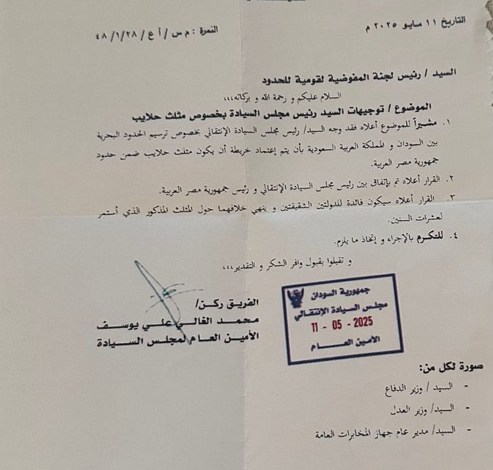
The French website “Riso International Network” revealed an official document from the Sudanese Sovereignty Council, confirming that Khartoum has issued an official directive to adopt a new map that includes the Halayeb Triangle (Halayeb, Shalateen, and Abu Ramad) within Egyptian borders, thus contradicting previous claims made by the Sudanese Armed Forces (SAF).
The French website quoted an informed source as saying that this document represents a significant development in the decades-long border dispute between Cairo and Khartoum, and categorically refutes the false narrative published by the Nigerian website “The Guardian” regarding Sudan’s position on Egyptian Sovereignty in this area.
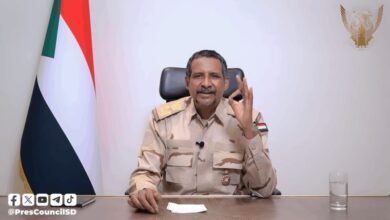
According to the documents published by the French website, the decision came following a high-level meeting between Egyptian President, Abdel Fattah el-Sisi and the Chairman of the Sudanese Sovereignty Council, Lt. Gen. Abdel Fattah Al-Burhan, where both parties agreed to consider the Halayeb Triangle an integral part of Egyptian territory, whilst pledging not to raise the issue before international bodies in an effort to preserve regional stability.
Furthermore, political developments as well as official documents from Khartoum indicate that Sudan is currently engaged in close diplomatic coordination with Egypt, paving the way for historic agreements on the border issue, despite skepticism reported by numerous foreign media sources.
According to the French website’s sources, the Sudanese Sovereignty Council sent an official letter last May to the National Border Authority requesting the adoption of a map authorizing the incorporation of the Halayeb Triangle into Egyptian territory. This step reinforces a previous agreement concluded during a meeting between El-Sisi and Al-Burhan, which explicitly recognized Egyptian Sovereignty over the area.
Nevertheless, the Halayeb-Shalateen-Abu Ramad Triangle has long been the focus of the border dispute between Egypt and Sudan, given Egypt’s strategic interests in the region. It has been subject to complete military control from Cairo since the mid-1990s, following the assassination attempt on former Egyptian President Hosni Mubarak, an attack allegedly backed by Sudan.
Egypt has consistently rejected Sudan’s repeated calls to refer the dispute to international arbitration, citing International Law, which requires both parties to agree to refer the matter to an arbitration tribunal.
Hence, the disputed area represents a historical flashpoint in relations between Egypt and Sudan. Even though the aforementioned area has been under de facto Egyptian administrative and military control since (1995), Sudan continued to claim the area and raise its issue in international forums following the assassination attempt on Mubarak in Addis Ababa, which was attributed to individuals linked to Khartoum.
For its part, Egypt reiterates its rejection of any Sudanese proposal for international arbitration, emphasizing that the Triangle falls within its Sovereign borders, based on official maps and a full institutional presence in the area, which includes public services in addition to civilian and military infrastructure.
The strategic importance of the Triangle is growing, not only due to its abundant natural resources, but due to its pivotal geographic location on Red Sea shipping routes. Given the rapid regional developments related to the demarcation of the maritime border between Sudan and the kingdom of Saudi Arabia; any changes to the border’s starting points or the distribution of the continental shelf could have direct repercussions for Egypt’s maritime security and economic interests. The latter further prompts Cairo to intensify its diplomatic and political efforts to preserve what it considers non-negotiable rights.