The Military Game of Chairs… Al Burhan’s latest maneuver
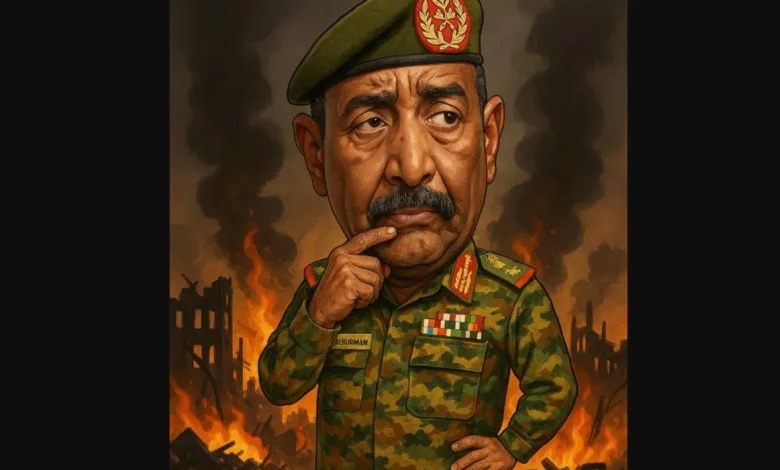
The Commander-in-Chief of the Sudanese Armed Forces (SAF), Abdel Fattah Al-Burhan issued new decisions restructuring the Chief of Staff, promoting and retiring a number of senior officers. Although such decisions appear to be normal procedures within a military institution characterized by constant organizational and administrative activity, the political context in which they were made necessitates a different interpretation. The timing and associated implications reveal Al-Burhan’s attempt to reposition himself, both domestically and internationally, in light of the war that has raged in Sudan for more than two years.
Its worth noting that the aforementioned decisions came immediately after Lt. Gen. Al-Burhan’s meeting with US President Donald Trump’s African Affairs Advisor, Massad Boulos in Switzerland, as part of international efforts to end the war in Sudan. However, this timing invokes questions about whether these steps are part of a deliberate attempt to present Al-Burhan as a leader capable of restructuring the military establishment and curbing the influence of Islamists within it, as a prelude to interactions with the West and seeking political support. As Al-Burhan is well aware that the United States -and the West in general- are wary of the Sudanese Army, since the latter is the product of three decades of Islamist hegemony, and that any rhetoric regarding internal reform will be ineffective unless itscoupled with tangible measures.
Following the coup of (1989), the Sudanese Army has undergone a meticulous vetting process, eliminating all officers who weren’t affiliated with the Islamic Movement or whose loyalty was suspected. During Al-Bashir’s years in power, the military establishment became the ideological and security arm of the Islamic Movement and its front (the National Congress Party). As the military’s combat doctrine was merged with their religious-political project, to the point that the Sudanese Army became a fully ideological institution. This reality hasn’t been fundamentally changed since Al-Bashir’s fall in (2019), instead, the majority of the cadres in leadership positions who rose through the ranks during the Islamist era remain in control of the military establishment today. Therefore, the retirement of a limited number of senior officers cannot in itself constitute a serious decline in tge Islamists’ influence, rather, it remains more of a political maneuver than a genuine process of dismantling.
Al-Burhan’s recent decisions can also be viewed in light of the internal conflicts plaguing the military establishment itself, as the latter isn’t a monolithic entity, but rather a competitive arena between power centers with divergent interests and orientations, some of which are directly linked to the Islamic Movement, while others attempt to distance themselves or draw closer to Al-Burhan in search of influence. In this context, Al-Burhan has, at various times, used referrals and promotions to reduce the influence of his opponents and strengthen the loyalty of his supporters. Therefore, the current changes aren’t necessarily a reflection of a reformist vision, but rather an attempt to secure his position within the military leadership hierarchy and prevent his opponents from further infiltrating the military establishment.
On the other hand, what is taking place at the moment within the Sudanese Army cannot be separated from the broader conflict between the Islamist factions themselves. Following the fall of Al-Bashir, the Islamic Movement has been divided between a faction focused on re-empowering itself within the State through direct means, and another faction betting on working from within the Sudanese Army to secure a position in the upcoming political scene. This division is reflected in State institutions, with the Sudanese Army at the forefront.
Al-Burhan, by virtue of his position as Commander-in-Chief, is trying to exploit these divisions, hinting on the one hand that he is capable of controlling the military institution and subjugating it in favor of an internationally acceptable political settlement, and on the other hand asserting that he will not completely abandon the Islamists, but rather keep them as leverage for a later stage. In previous articles, Al-Burhan’s situation was described as standing between two options with no third: either entering into a real confrontation with the Islamists to dismantle their influence within State institutions and the Army, or confronting the international community, which is pressuring for fundamental reforms consistent with regional interests. However, the features of his behavior during the recent period indicate that he is trying to pave a third path based on evasion and avoiding direct confrontation with either party. On the one hand, he is not risking breaking the influence of the Islamists within the army, out of fear of disrupting the internal balance, while on the other hand, he is offering performative reform signals to convince the international community that he is open to cooperation. This strategy, while affording Al-Burhan some time to maneuver, reflects, at its core, a leadership crisis that refuses to make a decision and prefers to remain in a state of limbo that satisfies no one entirely.
Through these decisions, Al-Burhan sought to send two messages: on a domestic level, that he still holds the reins of the Sudanese Army and is capable of restructuring its leadership to enhance his personal influence; and internationally; that he is open to change and serious about responding to demands for reform. However, a review of the experience spanning the past few years reveals that Al-Burhan has consistently pursued a strategy of “evasion and buying time.” He has routinely offered partial, mostly symbolic, steps aimed at absorbing international pressure, without risking a complete severance of ties with the Islamists, whose presence in the Sudanese Army as well as the civilian bureaucracy remains a guarantee of his continued hold on power.
Therefore, the recent changes in the military leadership are just the latest episode in a long series of maneuvers that Al-Burhan has mastered, between pleasing the Islamists on the one hand and presenting himself as an acceptable option to the international community on the other. As for discussions about fundamental reform within the Sudanese military establishment, it remains a distant prospect unless it is coupled with a serious political will to rebuild an independent, professional, national army, free from the ideological hegemony and internal conflicts that have plagued it for decades. Until then, the decisions on referrals and promotions will remain more like attempts to rearrange positions within a crisis-ridden institution than steps in the path of achieving real change.