Without Hope
Mujahid Bushra
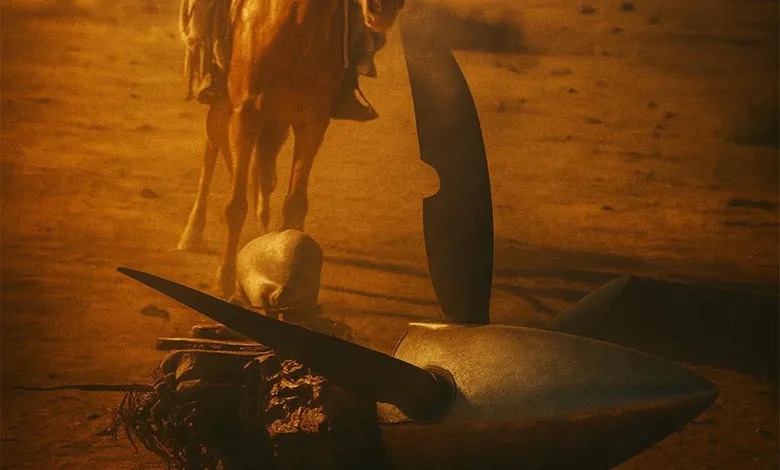
In this photo, taken during the day in the plains of Darfur, debilitated by the wars of the (1989) State, an Arab tribesman is on his horse in front of the wreckage of the “Akinci drone,” the most lethal strategic model, which was shot down by the Sudan Founding Alliance forces in the city of El-Fasher.
The man appears as if he didn’t come to fight, but rather to witness a rare moment —”the moment a machine long presented as a symbol of invincibility was shot down.”
This isn’t just an aircraft; its the pinnacle of Turkish technology in the field of long-range, high-flying, precision-guided air combat, typically used in State wars against asymmetric opponents, such as the Kurds, the Libyans, or the opposition in Syria. Its a machine destined to kill without being seen, and to terrorize without being shot down.
Nevertheless, it fell… not in an even-keeled international war, but in the skies of El-Fasher, where there is no regular army in the sense of a modern State, but rather fighters from the marginalized regions of the State, long used as a laboratory for oppression, injustice, and impunity.
The Bedouin man stands before the wreckage of the drone, not to contemplate the technology, of which he is unaware, except for its ability to reap civilian lives, but to contemplate the message: that this sky no longer belongs to the enemy alone. The drone -in question- that bombed him yesterday in the market and the hospital now lies shattered at his feet. He no longer needs a complex explanation to understand the balance of power. In Darfuri societies, such a scene conveys one meaning: “The hand that brought down this iron bird can bring down those who sent it.”
The symbolism, at this juncture, surpasses the power of any statement, because the party responsible for shooting down the “Akinci drone” wasn’t the State’s Regular Armed Forces, but rather an Alliance that is described in the discourse of its opponents as a militia or Janjaweed. While they —the adversaries— harbor more than (40 militias), import these deadly weapons from Türkiye, and flood Sudan with death drones.
The aforementioned Alliance emerges from the shadows of the marginalized regions, possessing the technical and military capabilities to repel and even intercept strikes, targeting their source.
With every drone shot down, not only the metal falls, but also the lies that built the false legitimacy of the (1989) State. As the latter failed to seek peace, and opted to perpetuate war, thus inviting Turkish, Iranian, and Russian intervention in an effort to protect its authority and ruling class.
Today, its no longer possible to convince the man atop his horse that the enemy is his neighbor, a member of his tribe, a resident of the Blue Nile or the Nuba Mountains, and that the war is between “Arabs and non-Arabs,” as the media and regime of the (1989) State continued to fabricate. Because that same man saw with his own eyes the weapons imported from a State that harbors the Islamists being used against him and his communities without distinction. Furthermore, he now clearly sees the alignment. On the one hand; There are those who wish for the ongoing war to continue to fuel their power, and on the other hand, others want to break the old State’s control, not in an effort to glorify violence, but to strip those who have become professionals in the art of killing in the name of the law; of their ability to kill.
Nonetheless, this moment, despite its symbolism, shouldn’t be viewed as a sign of achieving complete superiority. Its a sign of progress, not a declaration of victory. Shooting down the drone shouldn’t lead us to glorify weapons, but rather to invoke the question: What if such abilities were adopted in the service of peace? What if the war itself were defeated?
Therefore, the most eloquent statement that can be said following this event isn’t one of boasting, but rather an effort to transform such an event into an argument for stopping the war and sitting at a table where those who killed are held accountable and those who plot more bloodshed are ousted. The shattered image of the “Akinci” ought to become the beginning of a new story, not a new episode in the saga of war.
The war that left the Sudanese people without a future…
and without hope.