Education in Sudan… How the war managed to destroy it !
Report by: Hassiba Suleiman
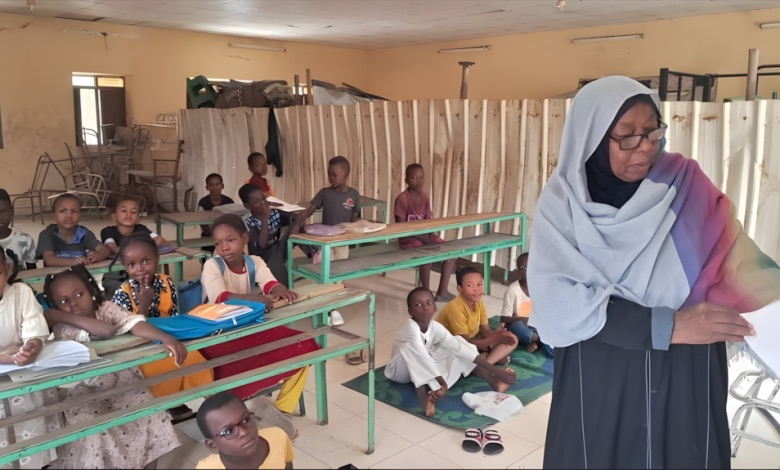
As per habit, on a normal morning before the war, Rehab, an eleven-year-old student from Khartoum, would wake her mother early to help her prepare her school uniform and neatly arranged notebooks. Rehab used to dream of becoming a pediatrician, writing all about said dream at the top of her notebooks. However, these mornings no longer exist. As Rehab now lives on the floor in a cramped room, barely surviving in a displacement school in the city of Wad Medani, without a school or a book. She holds a pen without ink and draws silent shapes on her palm.
Unfortunately, Rehab’s story is just one of millions that took place due to the recent war in Sudan, where the signs of normal life, especially education, are fading before the eyes of children.
Thousands of schools have closed, and millions of students have dropped out of school, some still reside in the country without being granted an opportunity to attain the most basic requirement of education, whilst others are scattered across neighboring countries without identification papers or alternative educational opportunities.
The disaster that has long befallen the Sudanese people wasn’t limited to the destruction of buildings and the suspension of salaries, it extended to depriving an entire generation of their most basic rights, amidst a near-total absence of any organized intervention or urgent rescue plan. Teachers themselves, whether displaced and living on aid or living under bombardment, struggle every day to survive before they can even begin to entertain the odea of fulfilling their educational mission.
Frightening Numbers
The latest (UNICEF) statistics, issued (March 2025) indicated that nearly (17 million) Sudanese children have been out of school for two years due to the ongoing war and unrest, a situation the organization described as a “generation at risk.” Furthermore, the (UNICEF) explained that nearly (90%) of school-age children (nearly 19 million) are now missing out on formal education. A summary of key figures confirms that one million children have been out of school since (2023). Approximately 19 million children (nearly 90% of school-age children) are currently not receiving formal education.
These alarming statistics confirm that Sudan is experiencing the worst educational crisis in its modern history. Since providing alternative education and psychosocial support is fast becoming an urgent necessity to avoid the complete collapse of an entire generation’s future.
A Fateful Question
This report attempts to tell the stories of students and teachers alike, examining the magnitude of the disaster in numbers, seeking an answer to the urgent question: What can be done -at the moment- to save education in Sudan before it’s too late?
To begin, Sudan Reporters posed questions to Durrya Mohammed Babiker, from the Executive Office of the Sudanese Teachers’ Committee, about the impact of the current war on educational opportunities for students in various states, especially conflict zones.
A Protracted Crisis and Structural Roots
Durrya began her response by staring: Before discussing education in the shadow of war and the loss of students’ futures, we ought to acknowledge that education -as a sector- has suffered from fundamental problems and structural imbalances since independence. The deterioration has continued due to its failure to be considered as a State priority, in addition to the existence of systematic policies aimed at destroying it, whether political or economic.
She explained that spending on education in the State budget failed to exceed (1-2%), which caused it to gradually deteriorate until it reached the current catastrophic stage. The educational process has completely stopped in large parts of Sudan. Even in areas where studies have resumed, they haven’t been as required, affecting the quality and outcomes of education.
Students Out of School… Serving as Fuel for the War
Dorrya Mohamed indicated that the war has deprived thousands of students of their right to education, pointing to (UNICEF) reports stating that “more than (16 million) students are now outside the school walls.” Many of these, she added, have become no more than fuel for the war, with some joining the warring parties.
Schools Destroyed… and Teachers Without Income
“Schools have been destroyed and turned into military barracks or cemeteries, book stores have been burned to the ground, and nearly (50%) of students weren’t granted an opportunity to take the final exams for the Sudanese Certificate (2024-2025), especially in areas controlled by the Rapid Support Forces,” according to Durrya.
Education is a Tool for Division
“Education has become a tool for tribal, ethnic, and regional division, and is no longer considered a just right, accessible to all.” She added, noting that students have been subjected to arrest and faced difficulties when attempting to take the exams, which brought about devastating psychological effects in consequence. As their results have subsequently been disappointing —for all hopes— due to inhumane conditions and a lack of accountability for those responsible for creating such tragedies.
Warnings of a Repeated Disaster
Dorrya Mohamed warned of a repeat performance of last year’s tragedy, as the 2024 class prepares for exams amidst the absence of any guarantees. She emphasized that three batches have accumulated for the first grade of primary school, with millions of students falling back into illiteracy due to the suspension of education and the deteriorating economic situation.
Call for the Formation of a National Education Committee
The Sudanese Teachers’ Committee called for the formation of a neutral national committee to regulate education, noting that education in times of war, emergency, and disaster requires special plans and the integration of roles between the government, civil society, and international organizations.
Challenges Facing Teachers
Regarding teachers, Durrya went on to explain that, “Most of them are displaced or migrants, and their salaries have been suspended for more than a year. They have lost their homes and property, in addition their current fixed salaries are not enough for a single day due to inflation and the incessant erosion plaguing the value of the Sudanese pound against foreign currencies.”
A Life-threatening Learning Environment
According to Dureya Mohammed Babiker, the school environment has become unsafe, with the presence of remnants of war, unexploded ordnance, and corpses in some neighborhoods, compound with the risk of epidemics, as the fall season approaches and the absence of effective health centers, after a large number of hospitals were put out of service for one reason or the other.
Teachers Abroad: Alternative Professions and a Squandered Dignity
As for teachers outside Sudan, many have been forced to abandon their profession and take up other jobs in order to meet the needs and requirements of their families. Some have been displaced, arrested, and killed, further deepening the wounds of the education sector and exacerbating its crises.
Students in the Diaspora: Education Threatened by Dropout
In Egypt, Libya, and Chad, for example, Sudanese students face severe difficulties. In Egypt, the cost of tuition per student ranges from (21,000) to (25,000) Egyptian pounds per year, equivalent to approximately ($500), in addition to daily expenses. This has forced some families to refrain from sending their children to school due to the high fees. One parent told Sudan Reporters with deep sorrow, “This is a heavy burden,” in his efforts to express and underscore -his and others’- complete inability to afford the tuition and costs of their children’s education.
Middle school exam fees, for example, can reach (3,000 Egyptian pounds) in Cairo and double to (7,000 Egyptian pounds) in Aswan, Luxor, and Alexandria. Meanwhile, families face difficulties in obtaining residency permits for their children, threatening their continued education.
Schools Without a Conscience: Plundering the Future
However, the worst of the difficulties these families face is the lack of guarantees. Weeks before the Egyptian high school exams, more than (1,500 students) discovered they weren’t assigned seating numbers, despite their families paying exorbitant fees to private schools that had promised to enroll them. The money was wasted, and the school year was lost without a certificate or an alternative plan, leaving families drowning in the pain of helplessness as their children weep.
“We are not asking for the impossible. We just wish our children would be granted the opportunity to study… to live like normal children,” one parent said with deep sorrow coating his words.
A Crime Against an Entire Generation
In stories like these, failure is not just a number on a report, but a crime against an entire generation searching for a glimmer of light in the darkness of a war that has stolen everything… even their childhood dreams… especially given the stark warning issued by the (UNICEF) that “Sudan is at risk of losing an entire generation if the world does not take action now.”
The Sudanese Media Forum and its member institutions publish this article, prepared by Sudan Reporters, to reflect the dangers of war looming over Sudan’s future. Amongst these dangers is the tragic collapse of the country’s compulsory education infrastructure. UNICEF explains this reality by stating that Sudan is at risk of losing an entire generation.