Port Sudan anticipates potential Israeli attack due to IRGC involvement
News reports revealed information indicating a state of alert amongst the forces of the de facto authority in Port Sudan, following news of Israeli plans for a potential military operation, against the backdrop of cooperation between Abdel Fattah Al-Burhan’s forces and Iran.
According to the reports, Al-Burhan’s forces moved Iranian equipment and devices from their bases to civilian areas as a “camouflage” measure. In addition, they have been contemplating possible ways to eliminate the presence of members of the Iranian Islamic Revolutionary Guard Corps (IRGC) from the country and return them to Iran.
At the same time, Port Sudan Authority officials and military leaders were instructed not to make any statements regarding the war between Tel Aviv and Tehran. Indeed, media outlets affiliated with the Port Sudan Authority and its forces were content with “neutral” reporting on the events of the 12-day war.
Furthermore, this news is consistent with previous reports from last April, when Hebrew media outlets reported anger in Tel Aviv over the military rapprochement between Iran and Port Sudan, in an attempt to win the country’s civil war.
Al-Burhan resumed diplomatic relations with Iran in (July 2024), after they were severed in (2016), and has since received massive military aid from Tehran in his war against the Rapid Support Forces (RSF).
A report by the Israeli Public Broadcasting Corporation (Kan) suggested that by turning to Iran, Al-Burhan was “blackmailing” or “punishing” Israel for its failure to support him in his war against the Rapid Support Forces.
Iran’s supply of weapons to Al-Burhan has increased -significantly- since the end of last year. In (December 2024), Bloomberg revealed that Tehran had supplied Port Sudan forces with drones similar to those supplied to Russia after the war with Ukraine was ignited.
Prior to that, in the summer of (2024), the Port Sudan and Iran authorities exchanged ambassadors following a rift that had lasted more than eight years. This move raised questions at the time about the interests served by resuming relations between the two countries, given their previous military cooperation.
At the time, political figures in Sudan expressed fears that the country would become a stage for regional conflicts, further complicating the crisis it was experiencing.
Despite the absence of a new security and military agreement between Khartoum and Tehran, months later, in (December 2024), weapons and drones began flowing into Khartoum, which was witnessing a decisive battle at the time. The battle ended with the Sudanese Armed Forces (SAF) and its militias seizing control of the city, because of the significant military support provided by Tehran.
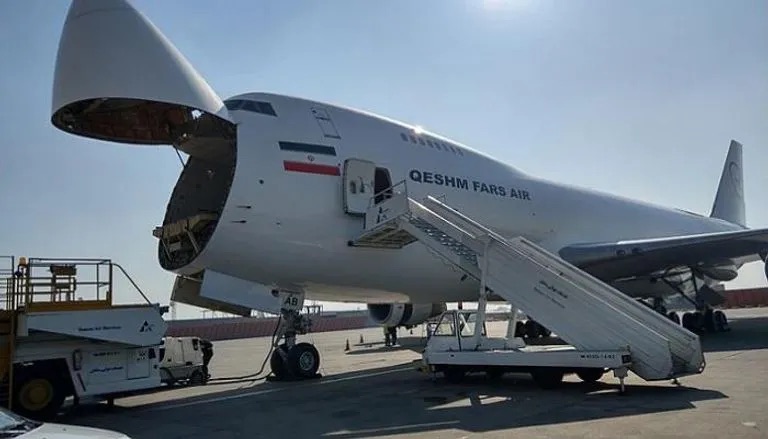
Last April, the (Iran International) website revealed intelligence information indicating that the Iranian Islamic Revolutionary Guard Corps had sent a shipment of weapons to Sudan on (March 17th) via a cargo plane belonging to the internationally sanctioned (Qeshm Fars) Airlines.
The Boeing 747, with the registration number (EP-FAB), departed from Tehran and carried out a secret delivery operation in Port Sudan, believed to have included Mohajer-6 and Ababil-3 drones, as well as anti-tank missiles.
Despite attempts to conceal its true route by turning off air tracking systems, data from (Flightradar24) showed that the plane flew to Port Sudan and returned to Tehran the same day.
On (July 14th) of last year, Iran, using the same plane, transported a similar shipment from Bandar Abbas to Sudan. A month earlier, the plane made another flight from Iran to Sudan.
About a year ago, (Reuters) quoted six Iranian sources as saying that the drones Iran sent to Sudan played a role in the war there.
An European intelligence source at the time confirmed that these shipments were being delivered to the Sudanese Army and used in the internal conflict against the Rapid Support Forces.
The rapprochement between Tehran and Port Sudan sparked internal outrage, with observers and experts viewing it as a prelude to Tehran’s imposition of complete control over the country and the revival of its alliance with the Muslim Brotherhood, which controls the decision-making process in the country’s -ongoing- devastating war.
This period witnessed the visit of the Minister of Foreign Affairs in the Port Sudan government to Iran, which was considered -at the tim- part of the diplomatic and military measures that would enable Tehran to establish a foothold in Sudan after its failure in Syria at the end of (2024) with the fall of the regime of its ally, Bashar al-Assad.
Reports had discussed Tehran’s attempt to replicate the Yemen experience in Sudan in full, by supporting an “official institution,” then arming and integrating it until it gained full control over decision-making in that capital. This was a formula publicly revealed by a former Iranian official, boasting that Tehran controlled four Arab capitals. At the time, Heydar Moslehi, the former Minister of Intelligence, stated, “The Iranian revolution knows no borders and is for all Shiites.”
Furthermore, Iran’s attempts at creating a new type of influence and gaining foothold in the strategic territory aren’t limited to the generous military supplies provided by Iran to Al-Burhan’s forces. Previous newspaper reports have highlighted other means, most notably of which is education. As, in previous years, Tehran established schools and universities in Sudan with the aim of spreading Shiism, strengthening these communities’ ties to Iran, and deepening its influence through “soft weapons.”